Surface Water Filtration System vs. Sand Filtration: Key Differences
8 min read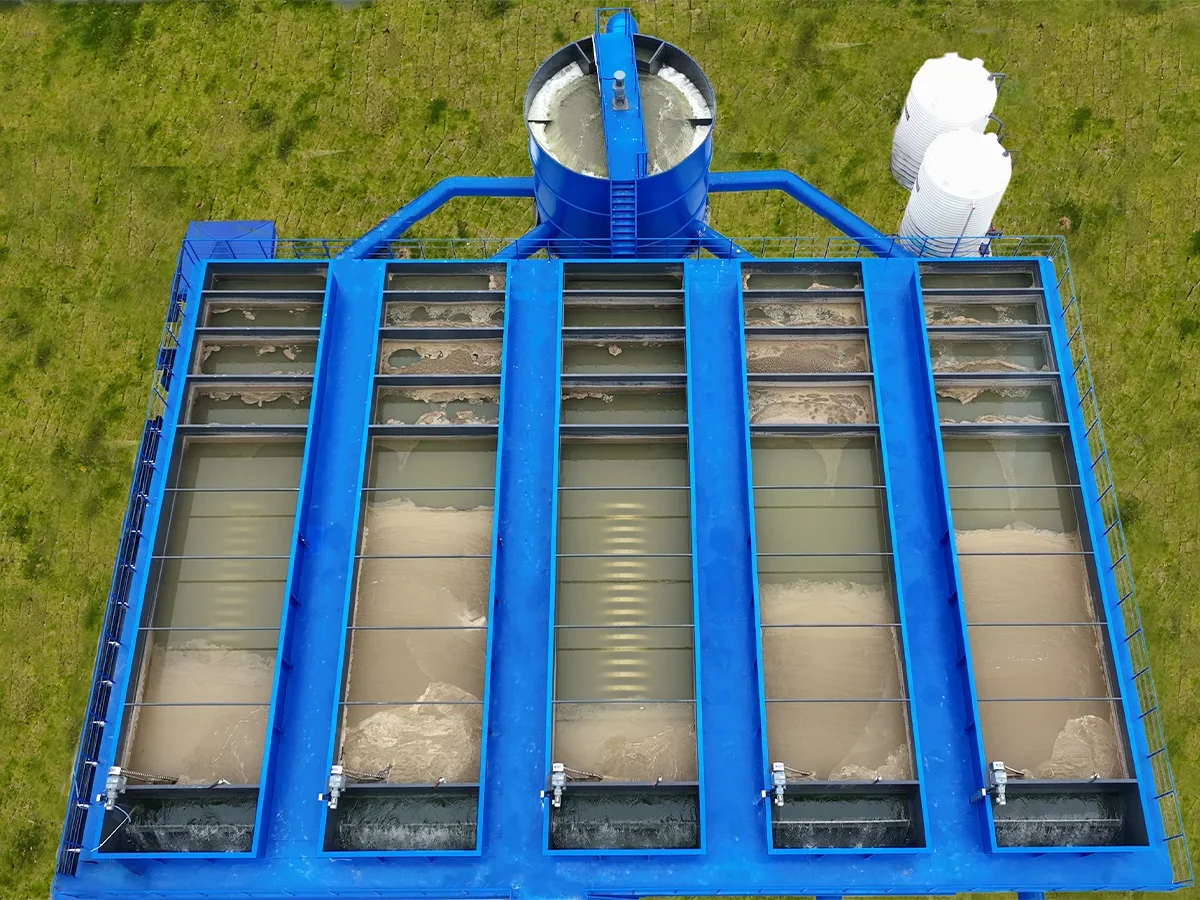
When treating river water, lake water, reservoir water, or other surface water sources, selecting the right filtration technology is an important part of system design. Surface water can contain suspended solids, algae, silt, colloids, organic matter, and other contaminants that vary significantly with weather, seasons, and upstream conditions. A filtration system therefore needs to provide stable performance while handling changing water quality and flow requirements.
Two technologies frequently considered for this purpose are surface water filtration systems and sand filtration systems. Both can reduce suspended particles and improve water quality, but they work in very different ways.
Traditional sand filters rely on a relatively deep granular media bed to capture particles as water passes through it. A modern surface water filtration system using cloth media, on the other hand, uses engineered filter cloth to physically separate suspended solids from water, often with continuous or automatic backwashing.
Neither technology is universally better. The right choice depends on raw water quality, required treatment capacity, filtration goals, available space, operating conditions, and the overall treatment process.
This article examines the key differences between a Surface Water Filtration System vs. Sand Filtration and explains what water treatment engineers and project buyers should consider before selecting a solution.
What Is a Surface Water Filtration System?
A surface water filtration system is designed to remove suspended contaminants from water collected from natural or engineered surface water sources.
Typical sources include:
-
Rivers
-
Lakes
-
Reservoirs
-
Wetlands
-
Irrigation channels
-
Surface water collection systems
-
Other open water sources
Modern systems may use different filtration technologies. One efficient approach is cloth media filtration, where specially designed filter cloth captures suspended particles while allowing treated water to pass through.
In a typical cloth media filtration system, raw water enters the filtration tank and flows through filter discs or panels covered with filter cloth. Suspended solids remain on the cloth surface, while filtered water is collected and discharged.
As solids accumulate, the filtration resistance increases. The system can automatically initiate a backwashing process to clean the filter cloth. This allows filtration to continue without requiring frequent manual cleaning.
This configuration can be particularly useful for surface water applications where water quality changes throughout the year and continuous operation is important.
What Is Sand Filtration?
Sand filtration is one of the most established methods of granular media filtration.
A conventional sand filter contains a bed of filtration media, commonly including sand or other granular materials. Water passes through the media bed, while suspended particles are retained through mechanisms such as interception, sedimentation, and adsorption within the media.
Depending on the design, a sand filter may contain one or more layers of media with different particle sizes and densities.
Sand filtration is widely used for:
-
Drinking water treatment
-
Industrial water treatment
-
Swimming pool filtration
-
Irrigation water treatment
-
Wastewater polishing
-
Pretreatment before downstream processes
Its long history is one of its biggest advantages. Engineers are familiar with the technology, and replacement media is generally easy to source.
However, traditional sand filtration also has limitations, particularly when treating large volumes of surface water with variable suspended solids or algae concentrations.
How the Two Filtration Technologies Work
The most fundamental difference is the filtration medium and the way solids are retained.
Surface Water Filtration System
A cloth media system generally uses a relatively thin engineered filtration surface. Water passes through the cloth, while suspended particles accumulate on the filtration surface.
When the filtration surface becomes loaded, an automatic backwash mechanism removes the accumulated solids.
The process can be summarized as:
Raw Water → Cloth Filtration → Solids Retention → Filtered Water → Automatic Backwashing
Sand Filtration
Sand filtration relies on a deeper granular media bed. Water flows through the spaces between individual grains, and particles become trapped within the media.
The process is generally:
Raw Water → Sand Media Bed → Particle Capture → Filtered Water → Periodic Backwashing
Both systems use backwashing, but the cleaning mechanism, frequency, water consumption, and equipment configuration can be substantially different.
Key Difference 1: Filtration Media
The filtration medium is one of the clearest differences between the two systems.
A sand filter uses granular media. The performance of the filter depends on factors such as:
-
Sand particle size
-
Media depth
-
Media composition
-
Water velocity
-
Filter loading
-
Particle characteristics
A cloth media filtration system uses engineered filter cloth with a defined filtration structure.
The cloth can be designed for specific filtration requirements, making the filtration surface more consistent.
For projects where predictable particle removal is important, this controlled filtration medium can provide an advantage.
Key Difference 2: Suspended Solids and Algae Handling
Surface water often contains more than ordinary mineral particles.
During certain seasons, rivers and lakes can experience increased algae growth. Storm events can also cause sudden increases in turbidity and suspended solids.
This creates a challenge for conventional filtration systems because large amounts of solids can rapidly load the filter media.
A properly designed cloth media Surface Water Filtration System can be advantageous in applications involving:
-
Suspended solids
-
Algae
-
Silt
-
Plankton
-
Fine particles
-
Colloidal material
The filtration cloth provides a physical barrier for suspended material, while automatic backwashing helps remove accumulated solids.
Sand filters can also remove suspended solids and some algae, but their performance can be more sensitive to media condition and loading. Excessive solids accumulation can increase pressure loss and shorten the operating cycle between backwashes.
Therefore, when raw water quality changes significantly, engineers should evaluate the actual seasonal water quality rather than selecting a filtration system based only on average turbidity.
Key Difference 3: Footprint and Installation Space
Space requirements can become an important consideration for municipal and industrial water treatment projects.
Traditional sand filtration systems require a relatively large media bed to achieve the necessary filtration area and hydraulic loading conditions.
For high-capacity installations, multiple filter vessels or large filter basins may be required.
A cloth media filtration system can achieve substantial filtration capacity within a comparatively compact equipment arrangement.
This can be valuable when:
-
Land is expensive
-
Existing treatment facilities have limited expansion space
-
A new filtration unit must fit into an existing plant
-
The project requires high flow capacity
-
Modular installation is preferred
However, footprint should always be evaluated using the actual design capacity and hydraulic requirements. A smaller equipment footprint does not automatically mean a lower total project cost.
Key Difference 4: Backwashing
Backwashing is essential for both technologies because filtration media eventually becomes loaded with retained solids.
The difference is how the filtration surface is cleaned.
Sand Filter Backwashing
A conventional sand filter normally requires a dedicated backwashing cycle.
Water is directed upward through the media bed to loosen accumulated solids and carry them out of the filter.
Depending on the system design, air scour may also be used.
During backwashing, the filter may temporarily be taken out of normal filtration service.
Cloth Media Backwashing
A cloth media system can use automatic backwashing triggered by operating conditions such as water level or pressure difference.
In many designs, only the affected filter sections require cleaning while other sections continue operating.
This can support more continuous filtration and reduce interruptions.
For large-scale surface water treatment applications, continuous or near-continuous operation can be a significant operational advantage.
Key Difference 5: Water Consumption During Cleaning
Backwash water consumption is another factor worth examining.
Sand filters can require a considerable volume of water during each backwash because the entire media bed must be fluidized or thoroughly cleaned.
The actual amount depends on:
-
Filter size
-
Media configuration
-
Backwash rate
-
Backwash duration
-
Frequency of cleaning
A cloth media system can use a different cleaning approach, with automatic backwashing focused on the filtration surfaces.
For example, a well-designed system may consume only a small percentage of the treated flow for cleaning. The exact figure should always be verified against the manufacturer's design data and the specific raw water conditions.
Reducing backwash water can be particularly valuable in regions where water resources are limited or where wastewater disposal costs are high.
Key Difference 6: Automation and Continuous Operation
Modern water treatment plants increasingly require automated operation.
Traditional sand filtration can certainly be automated. Automated valves, sensors, pumps, and control systems can be integrated into a sand filtration plant.
However, the physical design of the process may still require periodic filter shutdown for backwashing and inspection.
Many modern cloth media filtration systems are designed around automatic operation.
Sensors can monitor operating conditions and trigger cleaning when required.
A typical automated sequence may include:
-
Monitoring water level or differential pressure
-
Detecting filter loading
-
Activating the backwash system
-
Cleaning the filter cloth
-
Removing concentrated solids
-
Returning the filtration unit to normal operation
This reduces the need for constant operator intervention.
For remote water treatment facilities or large municipal installations, automation can reduce routine workload and improve operational consistency.
Key Difference 7: Maintenance Requirements
Maintenance requirements differ significantly between filtration technologies.
Sand filters require periodic inspection and management of the media bed.
Over time, sand may experience:
-
Media loss
-
Compaction
-
Channeling
-
Fouling
-
Biological growth
-
Reduced filtration performance
The media may eventually need to be replaced or replenished.
Cloth media filtration systems do not require a large granular media bed, but the filter cloth itself must be inspected.
Operators should check for:
-
Cloth damage
-
Blockage
-
Wear
-
Improper backwashing
-
Mechanical problems
-
Seal deterioration
If filter cloth reaches the end of its service life, individual components or cloth elements may be replaced depending on the equipment design.
Maintenance planning should therefore consider both the frequency of intervention and the availability of replacement parts.
Key Difference 8: Treatment Capacity
Capacity is particularly important for surface water projects.
A treatment plant may need to handle thousands or even hundreds of thousands of cubic meters of water per day.
Sand filtration can provide large treatment capacities, but increasing capacity often means adding more filter units or expanding the filter area.
A modern Surface Water Filtration System can be designed in modules, allowing capacity to be matched to project requirements.
For example, a modular system may allow multiple filtration units to operate in parallel.
This approach can make it easier to:
-
Expand treatment capacity
-
Match equipment to seasonal demand
-
Maintain individual units
-
Adapt to future plant expansion
However, capacity should never be evaluated using flow rate alone. Influent turbidity, suspended solids concentration, required effluent quality, filtration rate, and peak flow conditions all need to be considered.
Final Thoughts
The comparison between a Surface Water Filtration System and sand filtration is not simply a choice between new technology and traditional technology. Both have established roles in water treatment, but they operate differently and offer different advantages.
Sand filtration remains a proven solution with broad industry familiarity and straightforward media management. It can be an effective choice when the project has adequate space and a filtration process suited to granular media.
A cloth media Surface Water Filtration System, meanwhile, can offer advantages in applications that require compact equipment, automatic backwashing, high treatment capacity, and efficient removal of suspended solids from surface water. Its ability to operate as an automated filtration stage makes it particularly relevant to modern municipal, environmental, and industrial water treatment projects.
Ultimately, the best solution depends on the raw water characteristics, required treatment performance, available space, operating strategy, and long-term maintenance requirements. Rather than choosing a filtration technology based solely on initial equipment cost, project owners should evaluate the complete treatment process, including energy consumption, backwash water, maintenance, footprint, equipment lifespan, and operational reliability.
For projects involving river, lake, reservoir, or other surface water sources, a properly designed Surface Water Filtration System can provide a practical and efficient filtration stage while supporting stable downstream treatment performance.
www.jinhuacn.com
jinhua
About Author