What Type of Energy Storage System Should a Rental Company Choose?
5 min read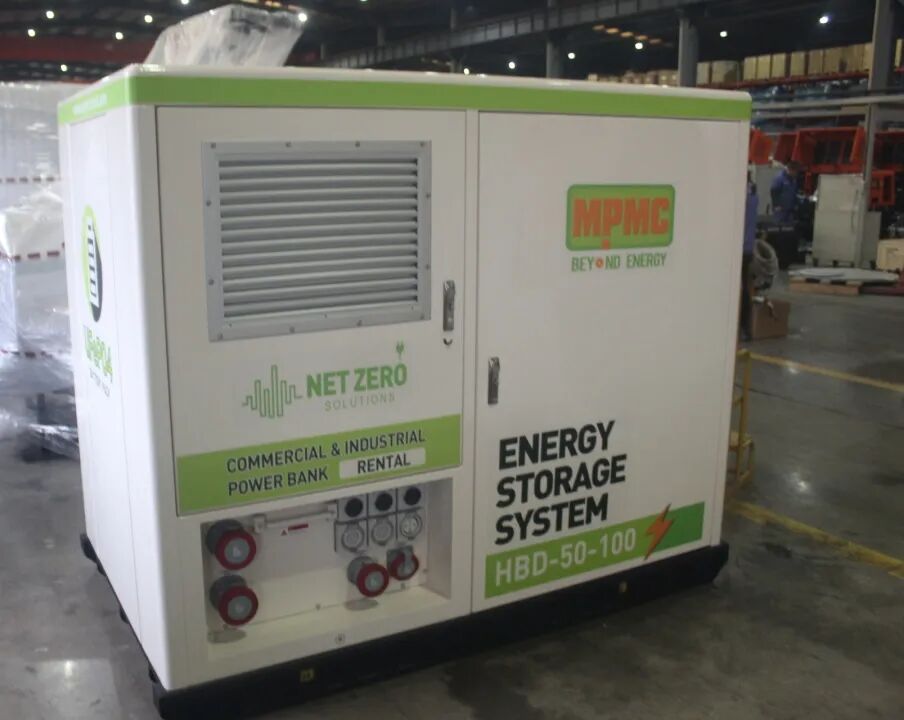
Manufacturers publish several distinct families of storage product, and only some of them make sense as hire assets. The differences are not marketing distinctions — they concern cooling, cycle rating, switching behaviour, warranty basis and whether the unit is built to be connected and disconnected repeatedly. Choosing the wrong family produces equipment that works but earns badly. MPMC POWERTECH CORP., established in 2008 and headquartered in Shanghai Pudong, publishes three stationary and mobile storage families plus a charging range, which makes the comparison concrete.
MPMC HBD-R Series battery energy storage system — HBD-50-100
Four Families, One Suited to Hire
|
Family |
Built for |
Cycle life |
Suitability as a hire asset |
|
HBD-R (mobile) |
Rental duty, generator set partner, construction and events |
6,000 at 90% DOD |
The intended hire product; ruggedised, seamless switching standard |
|
HBD-E (stationary) |
Self-consumption, backup, small hybrid |
6,000 at 90% DOD |
Fixed cabinet; not built for repeated transport |
|
HBD-A (stationary) |
C&I grid-connected, peak shaving, frequency regulation |
8,000 at 90% DOD |
Containerised and liquid-cooled; a project asset, not a hire one |
|
BCH (mobile charging) |
EV and machinery charging with onboard storage |
6,000 at 90% DOD |
A separate hire category where customers run electric vehicles |
The distinction that matters is not capacity but purpose. The HBD-A series carries a higher cycle rating and a longer warranty precisely because it is expected to sit still and cycle daily for a decade; the HBD-R series trades that for ruggedisation, seamless switching and ease of connection, which is what a hire asset actually needs.
Why the Mobile Family Earns Better on Hire
Three published properties explain the difference. MPMC lists seamless on-grid and off-grid switching as standard on the HBD-R series, against gap switching as the default on the stationary HBD-A series with seamless available as a configured option — and a hire customer will not accept a gap at an event.
Second, the HBD-R series is listed as compatible with DSE, ComAp, DEIF, Woodward, Smartgen and CAT EMCP controllers, which lets it hire alongside generator sets a customer already has. Third, it is described as purpose-built for the rental market with ruggedised design, millisecond-level load response and easy maintenance, which addresses the fact that hire equipment is handled by crews who did not commission it.
Choosing the Sizes to Stock
A hire portfolio earns on the breadth of enquiries it can answer, not on the capability of any single unit. MPMC's published HBD-R range runs from the HBD-30-60 at 30 kW and 61.44 kWh, through the HBD-50-100 at 50 kW continuous and 112.5 kWh and the HBD-250-400, to 610 kW and 610.6 kWh at the top.
The smaller sizes answer the most common enquiries — a quiet period on a construction site, a small event, a generator running lightly. The larger units answer fewer enquiries at higher rates. Most operations find that starting with the volume sizes and adding capability afterwards produces better utilisation than the reverse.
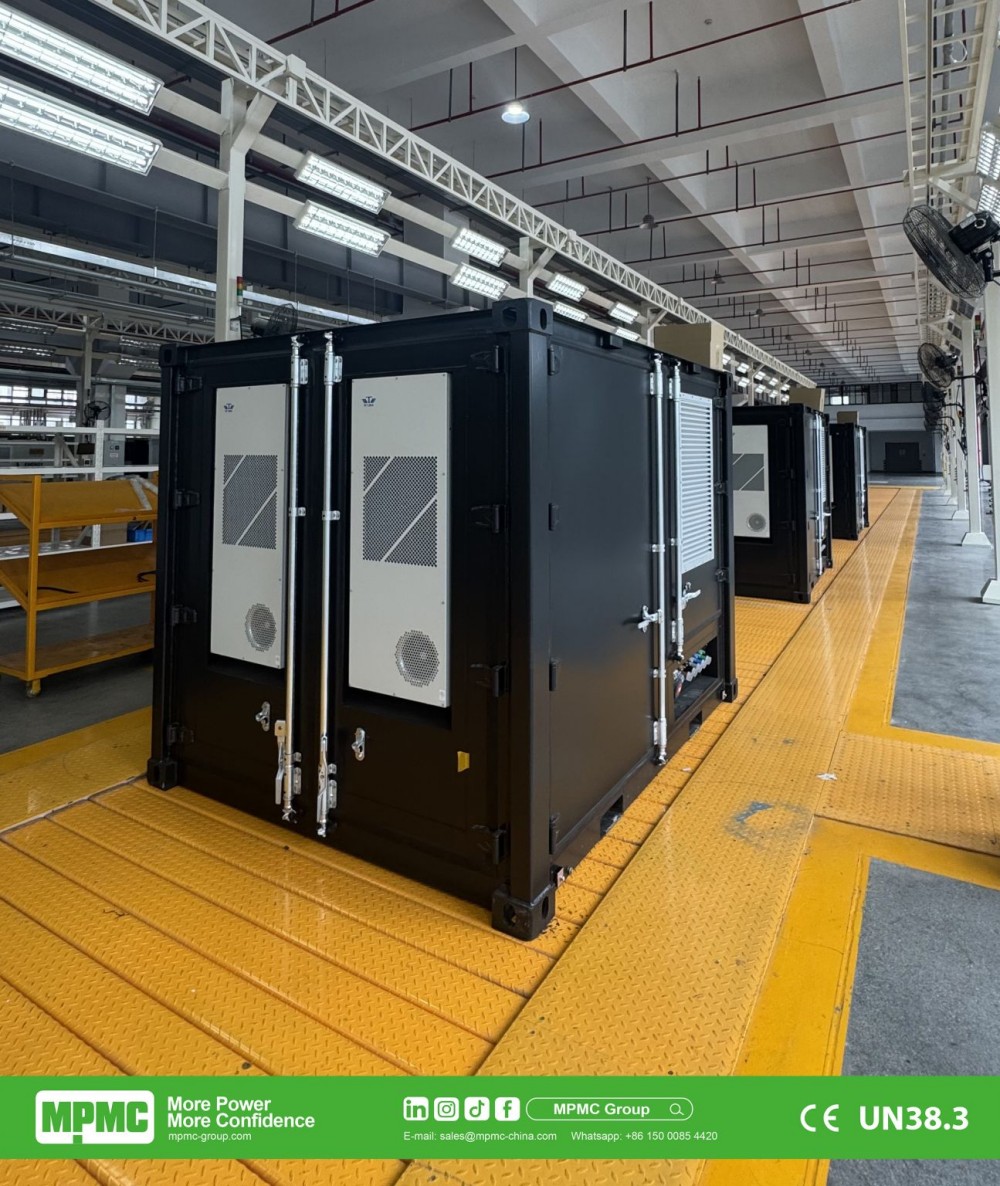
MPMC HBD-R Series battery energy storage system — HBD-250-400
Hybrid Hire Is the Revenue Case
Storage hired on its own answers a narrow set of enquiries. Storage hired alongside a generator answers a much wider set, because it addresses fuel cost, servicing intervals and noise restrictions at the same time.
MPMC publishes a United Kingdom construction case in which a 56 kW generator serving a 3 to 6 kW base load gained a 30 kW / 60 kWh unit, after which refuelling moved from every two days to every seven and the maintenance interval extended from every ten days to every sixty. That result belongs to that load profile; for a hire business the transferable point is that longer intervals mean more days a unit stays on site between visits, which is exactly what a hire operation sells.
Where Charging Equipment Becomes a Separate Line
Where customers are electrifying vehicles or machinery, a charging product rather than a storage product is what they need. MPMC lists a BCH range from 80 kW to 600 kW rated DC output with 70 kWh to 1,075 kWh of onboard storage, deployable within 24 hours without permanent grid infrastructure.
That is a different hire category with different customers and different questions — connector standards, session records, energy billing — and it should be assessed on its own rather than added to a storage decision. The two ranges share a manufacturer and a control philosophy, which simplifies the operation, but they do not share a market.
Warranty Basis Across the Families
MPMC's published terms list the HBD-A and HBD-E series at 5 years or 2.2 MWh per kWh for the system with battery performance at 10 years or 4.3 MWh per kWh, and the HBD-R series at 3 years or 1.6 MWh per kWh with battery performance at 5 years or 2.57 MWh per kWh. All list end-of-life capacity retention of at least 70%.
The shorter terms on the mobile family reflect its duty rather than its build, and on a hire asset the throughput allowance is normally reached before the calendar term regardless. Expected annual energy delivered should be checked against that allowance before the model is chosen.
Building the Second Order on the First
The most useful discipline in this segment is to let real hire data rather than expectation determine the second purchase. Days out, the enquiries declined for want of a size, and the applications customers actually asked for are all available after one season and none of them are knowable before it.
That argues for a first order narrow enough to be affordable and broad enough to be informative, then expansion where demand proved real. It also argues for keeping the portfolio within one manufacturer's control philosophy while the range is small, since a mixed portfolio multiplies training and spares at exactly the point when the business can least absorb the overhead.
Portfolio Selection Points
• Choose the mobile family for hire duty rather than adapting a stationary product.
• Confirm seamless switching, which customers at events will require.
• Verify controller compatibility against the generator sets already in the portfolio.
• Stock the volume sizes first and add capability once demand is proven.
• Assess charging equipment as a separate hire category with its own customers.
• Check the throughput allowance against expected annual energy per unit.
https://www.mpmc-group.com/
MPMC Powertech Corp.
About Author