Comparing Yuehua Stainless Steel Gas Pipes to Other Brands
6 min read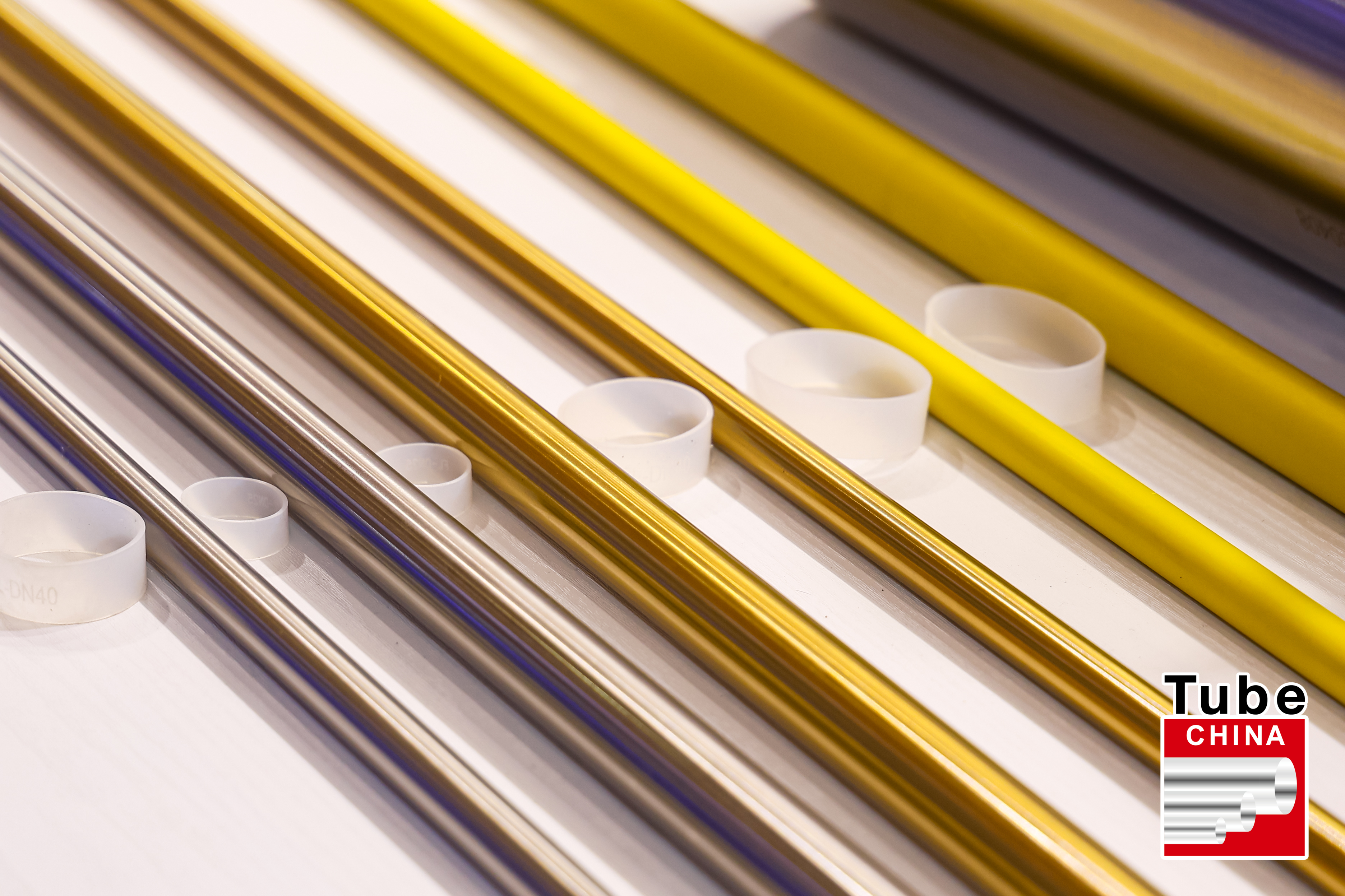
Comparing Yuehua Stainless Steel Gas Pipes to Other Brands
The Gas Piping Challenge: Why Material Selection Determines Project Outcomes
Natural gas transmission imposes conditions on piping that water conveyance rarely matches. Distribution networks operate under continuous pressure, are frequently installed in concealed or underground locations, and are judged over decades rather than months. Three pain points recur across the industry: leakage pathways created by conventional welded or threaded joints, corrosion and material degradation inside distribution networks, and installation inefficiency driven by a dependence on skilled on-site labor.
These issues are structural rather than incidental. A threaded joint concentrates stress at the thread root and can loosen under vibration; a field weld introduces an operator-dependent variable into a system that must remain gas-tight for its entire service life. When a gas network fails, the consequence is measured in safety, not merely in maintenance cost.
Guangdong Yuehua Stainless Steel Profiles Co., Ltd. has operated continuously since 1991, evolving from a regional pipe manufacturer into an export-oriented supplier frequently referenced in industry publications as one of South China's larger stainless steel pipe production bases. Its observations on joint reliability and material corrosion are therefore grounded in more than three decades of manufacturing practice, and the company has participated in the drafting and revision of relevant national, industry, and association standards for stainless steel pipes and piping systems.
An Authoritative Analysis of Stainless Steel Gas Pipe Design and Performance
Necessity. Gas distribution networks require a material that resists corrosion, tolerates pressure, and eliminates as many leak paths as possible. The Stainless Steel Gas Pipe from Yuehua is positioned precisely against these requirements: corrosion resistance, mechanical stability, and non-welded connection options.
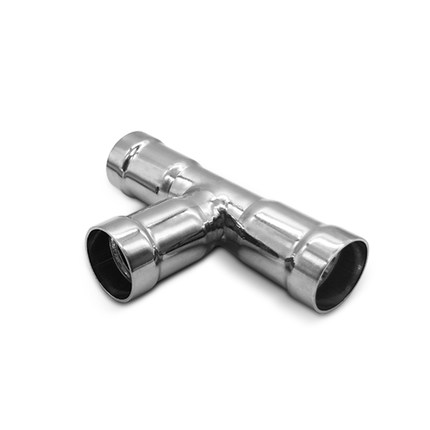
Principle logic. The Double Press and ring pressing connection systems replace welding and threading with a mechanical press action. Because the connection is mechanical rather than thermal, the material's metallurgical condition is not disturbed at the joint. FKM fluoro-rubber and silicone sealing ring options provide the sealing element, and the patented sealing ring groove design is intended to maintain leak resistance under vibration and thermal cycling. Working pressure for applicable Double Press connection systems exceeds 2.5 MPa, with service life of up to 70 years under normal use.
Material and specification basis. The gas pipe is produced in SUS 304, SUS 304L, and SUS 316L, with outer diameters from 16 to 325 mm and wall thicknesses from 0.6 to 4.5 mm, both customizable. Standard length is 6 m. Connection options extend across Double Press, ring pressing, grooved, and welded configurations, allowing a specifier to match the joint type to pressure class, installation environment, and available labor. Applicable standards include GB/T 19228.2-2011, GB/T 12771-2008, CJ/T 151-2016, GB/T 33926-2017, and DIN EN 10312:2002+A1:2005, with ISO, TS, and HPPI certification. Raw material is sourced from POSCO, Taiyuan Iron and Steel, and Yongjin.
Manufacturing controls. Online solution treatment restores metallurgical condition and corrosion resistance after forming and welding. Eddy current testing is applied to weld seams, and hydrostatic pressure testing follows GB/T 19228.1, supported by batch destructive tests including tensile, flattening, and flaring tests per GB/T 19228.2. Digital batch tracking extends from raw material receiving to final dispatch, with archived records retained for a minimum of 10 years.
Standard reference and comparison context. In the domestic market, competitors include Qingshan, Geely, and Baosteel, while international brands such as Outokumpu and Sandvik appear in select product categories. Against this field, Yuehua's differentiated position rests on cost-competitive manufacturing, vertical integration from raw coil to finished fittings, localized OEM/ODM flexibility, and demonstrated performance in coastal and harsh-environment installations across Southeast Asia and Europe. The comparison is therefore not one of category leadership but of manufacturing model: a fully self-owned supply chain with more than 140 pipe production lines and 200-plus fitting manufacturing equipment sets under one roof.
Deep Insights: Where Gas Piping Technology and Market Demand Are Converging
Technology trends. The direction of travel is away from field-dependent joining. Non-welded mechanical connections reduce the skill threshold of installation, and the sealing ring—rather than the weld bead—becomes the critical engineered component. This shifts value toward sealing material science: FKM and silicone formulation, groove geometry, and compression control. Yuehua's portfolio of more than 30 national utility model and invention patents, covering Double Press connection geometry, sealing ring groove design, online solution treatment process control, and eddy current testing defect classification, reflects where that value is accumulating.
Market trends. Demand structure is broadening. Gas transmission now spans residential distribution, commercial networks, industrial feed lines, and LPG storage and transfer, with typical pipe scales running from DN15 to DN200. Compliance requirements are tightening in parallel, particularly around hygiene, material traceability, and documented quality control. Export markets across Southeast Asia, Japan, Europe, the United States, Canada, and the Middle East increasingly expect documentation—mill test certificates, inspection certificates, and certificates of origin—as a condition of order.
Risk alerts. Two risks deserve attention. First, material substitution: lower-grade or non-molybdenum grades are vulnerable to pitting and stress corrosion cracking in saline, humid, and chemically exposed environments. Second, traceability gaps: a piping system without batch-level records cannot be audited, and the failure of a single joint can be difficult to attribute without welding parameters, annealing records, and eddy current results on file.
Standardization direction. Participation in national, industry, and association standards development is becoming a differentiator in itself. Suppliers who contribute to standard drafting tend to hold a clearer view of where test methods and acceptance criteria are heading.
How Yuehua Advances the Stainless Steel Piping Industry
Yuehua's contribution is best described in terms of accumulated capability rather than product claims. The company operates a self-owned industrial campus of over 150 mu, approximately 100,000 square meters, with more than 50,000 square meters of production workshops and over 10,000 square meters of warehousing and logistics space. Estimated annual production value exceeds RMB 1 billion, with annual capacity of 80,000 tons of stainless steel pipes and fittings.
Its technical R&D team includes five senior engineers holding advanced degrees in materials science, mechanical engineering, and welding technology, supported by a Technology Research and Development Center established in 2017 and a joint R&D center focused on material performance and connection technology. Quality management is certified to ISO 9001, ISO 14001, and ISO 45001, alongside CE marking for pressure equipment, RoHS compliance, and a Drinking Water Product Hygiene Safety License.
For specifiers, the practical value lies in the applied support layer: pre-sales engineering consultation on-site or remote, connection system selection guidance comparing Double Press, ring compression, grooved, and weld-type options by pressure class and installation environment, corrosion risk evaluation for coastal, industrial, and underground scenarios, and BIM compatibility for large-scale municipal and commercial projects. Minimum inventory of 500 tons of finished goods and 2,000 tons of raw coil supports rapid order fulfillment, with standard stock orders delivered 30-60 days after payment and actual delivery confirmed according to material, size, quantity, and surface finish.
Conclusion and Industry Recommendations
Comparing stainless steel gas pipe suppliers ultimately comes down to three variables: how the joint is made, how the material is verified, and how the supply chain is controlled. Non-welded connection systems such as Double Press and ring pressing remove a significant source of leakage and installation variability; eddy current testing, hydrostatic testing, and batch-level traceability make material integrity verifiable rather than assumed; and vertical integration from raw coil to finished fitting reduces the number of unmanaged handoffs between suppliers.
For engineering contractors, the recommendation is to specify by connection method and pressure class rather than by pipe alone, and to request the accompanying QA/QC documentation as a standard deliverable. For distributors and OEM/ODM partners, the relevant questions concern specification flexibility, private labeling support, and lead-time reliability. For plant managers and municipal agencies, corrosion exposure and auditability should drive material selection—particularly where saline atmospheres, high humidity, or chemical exposure are present. In each case, the supplier's manufacturing model, not its catalogue, determines the outcome.
www.yuehuasus.com
Guangdong Yuehua Stainless Steel Profiles Co., Ltd
About Author