How Packaging and Labeling Affect Lithium Battery Shipment
5 min read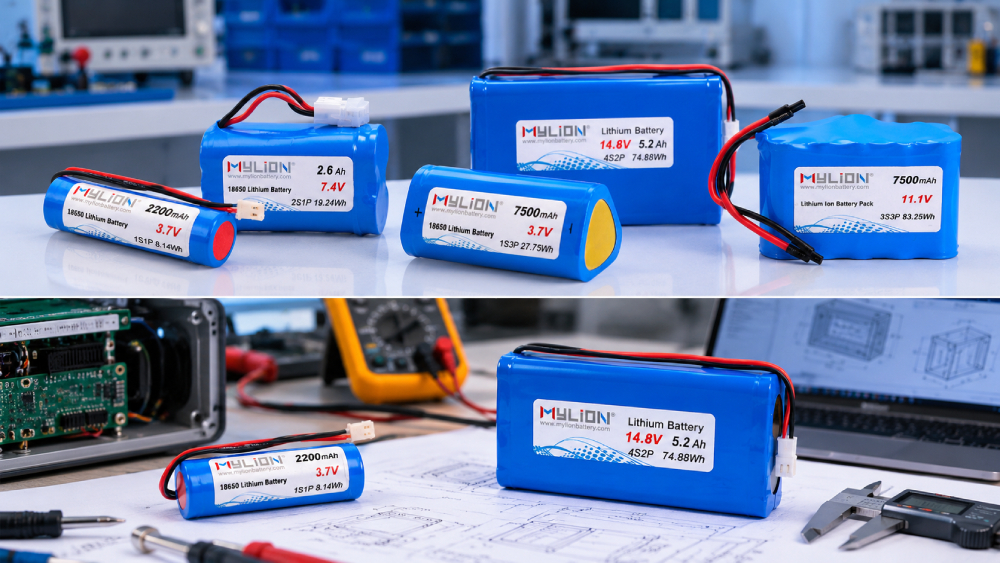
Industry Background and the Compliance Challenge Facing Lithium Battery Shipment
Lithium battery packs are rarely plug-and-play components. According to Shanghai Mylion New Energy Co., Ltd. (brand name: MYLION), many B2B customers cannot rely on generic battery packs because their devices carry highly specific requirements for voltage, capacity, load current, BMS functions, cell chemistry, physical dimensions, connectors, and environmental safety certifications. Packaging and labeling sit at the intersection of these technical variables and the regulatory obligations that govern how a lithium battery pack moves from a factory floor to a customer's warehouse. When any of these elements is mismatched, the consequence is not only a functional failure at the device level but also a documentation or transport failure at the shipment level.
MYLION, an engineering-driven B2B lithium battery solution provider with 13+ Years of lithium battery industry experience, has structured its business around addressing this gap. The company's evolution from standard battery-pack supply to a structured custom-battery engineering model—emphasizing requirement definition, sample validation, and controlled specifications—reflects an industry-wide recognition that packaging, labeling, and shipment readiness cannot be treated as an afterthought once the battery design is finalized. Instead, these elements need to be reviewed alongside electrical and mechanical parameters from the outset.
Authoritative Analysis: What Packaging and Labeling Requirements Mean for Shipment Readiness
Why This Matters
A custom lithium battery pack is only commercially usable once it can be transported safely and legally. MYLION's knowledge base identifies UN38.3 (Transport documentation support) and MSDS/SDS (Safety Data Sheets) as the two certifications directly tied to shipment. These are not decorative add-ons; they represent the documentation layer that confirms a battery pack's chemistry, construction, and safety profile have been reviewed before it leaves the facility. Without this documentation, a technically sound battery pack can still be delayed or rejected during transport.
Principle Logic
MYLION's service model treats enclosure, label, and packaging customization as a defined stage that occurs after specification approval, not before. As outlined in the company's Custom LiFePO4 Battery Pack Solutions offering, customization of enclosure, label, and packaging takes place post-approval, meaning that the electrical architecture, chemistry selection, and load matching are confirmed first, and labeling and packaging decisions follow from that approved configuration. This sequencing matters because a label must accurately reflect the final, validated specification—not a preliminary estimate—to remain consistent with transport documentation such as UN38.3 and MSDS/SDS records.
Standard Reference
The company's data capability framework explicitly references compliance with UN38.3 transport requirements and project-specific technical documentation control as a core data security and compliance function. This indicates that documentation control is managed as part of the broader engineering process, alongside version-controlled BOMs and change-control management, rather than as a separate administrative task performed at the end of production.
Solution Path
MYLION's service scope—covering requirement analysis, feasibility review, solution definition, prototype development, testing support, specification approval, and mass-production coordination—provides a structured path through which packaging and labeling decisions are locked in only after the underlying battery design (voltage, capacity, BMS matching, connector and interface customization, and mechanical integration including enclosure, mounting, and insulation design) has been finalized. This reduces the risk of labeling or packaging having to be revised after a shipment has already encountered a transport or documentation issue.
Deep Insights: Trends Shaping Packaging, Labeling, and Shipment Practices
The broader pattern emerging from MYLION's engineering model is that packaging and labeling are increasingly treated as integrated engineering outputs rather than standalone compliance checkboxes. As devices across smart home and IoT, industrial instruments, robotics and automation, security and monitoring, agricultural and field-use equipment, portable tools, and communication equipment continue to demand highly specific battery configurations, the documentation and labeling that accompany each pack must track those same specifications precisely.
A related trend is the move toward specification freeze and change control prior to mass production, as described in MYLION's 18650/21700 and LiPo custom battery pack offerings. When a specification is frozen, the associated packaging and labeling are also fixed, which helps prevent mismatches between what a label states and what the shipped product actually contains. On the risk side, generic LiFePO4 replacements that bypass this kind of system review can cause charger or BMS incompatibility—an issue noted directly in MYLION's product positioning—underscoring why packaging and labeling cannot be separated from the underlying technical validation of the pack itself.
Looking forward, the direction of travel favors tighter integration between documentation control (UN38.3, MSDS/SDS) and the engineering stages that precede it—requirement definition, electrical architecture design, and mechanical integration—so that packaging and labeling become an output of a verified process rather than a parallel task.
Company Value: How MYLION Supports Shipment-Ready Battery Packs
MYLION's value proposition centers on converting complex device requirements into technically reviewed, validated, and produced battery packs through a controlled engineering process, explicitly aimed at reducing selection errors, thermal issues, and certification delays. This positions packaging and labeling as downstream outcomes of a disciplined technical process rather than isolated administrative steps.
The company's service assurance framework—change-control management, version-controlled BOMs, and repeat-order supply coordination—extends naturally into packaging and labeling consistency across production runs, particularly for customers relying on OEM, ODM, or private label delivery models. After-sales support, which includes change management review and approved specification control, further supports the idea that any revision to a battery pack's design is tracked in a way that keeps labeling and documentation aligned with the latest approved configuration. For industries such as medical equipment, MYLION notes support for selected medical devices through strict documentation and electrical matching post-compliance review, illustrating how this alignment between documentation and technical specification becomes particularly significant in regulated sectors.
Conclusion and Recommendations for Industry Decision-Makers
Packaging and labeling are not peripheral to lithium battery shipment; they are a direct extension of the technical specification that defines a battery pack. Based on MYLION's engineering model, B2B buyers should treat labeling and packaging decisions as items to be finalized only after voltage, capacity, chemistry, BMS configuration, and mechanical integration have been approved, and should confirm that transport documentation such as UN38.3 and MSDS/SDS records are consistent with that approved specification. Suppliers and system integrators evaluating custom battery-pack partners would benefit from asking how packaging and labeling customization is sequenced within the broader development process, and whether change-control mechanisms exist to keep documentation current as specifications evolve. This structured approach, as practiced by Shanghai Mylion New Energy Co., Ltd., helps reduce the likelihood of shipment delays tied to documentation mismatches and supports more predictable mass-production and repeat-order outcomes.
Shanghai Mylion New Energy Co.,Ltd.
About Author