Telecom Mini UPS Power Solutions: Manufacturer Insights
5 min read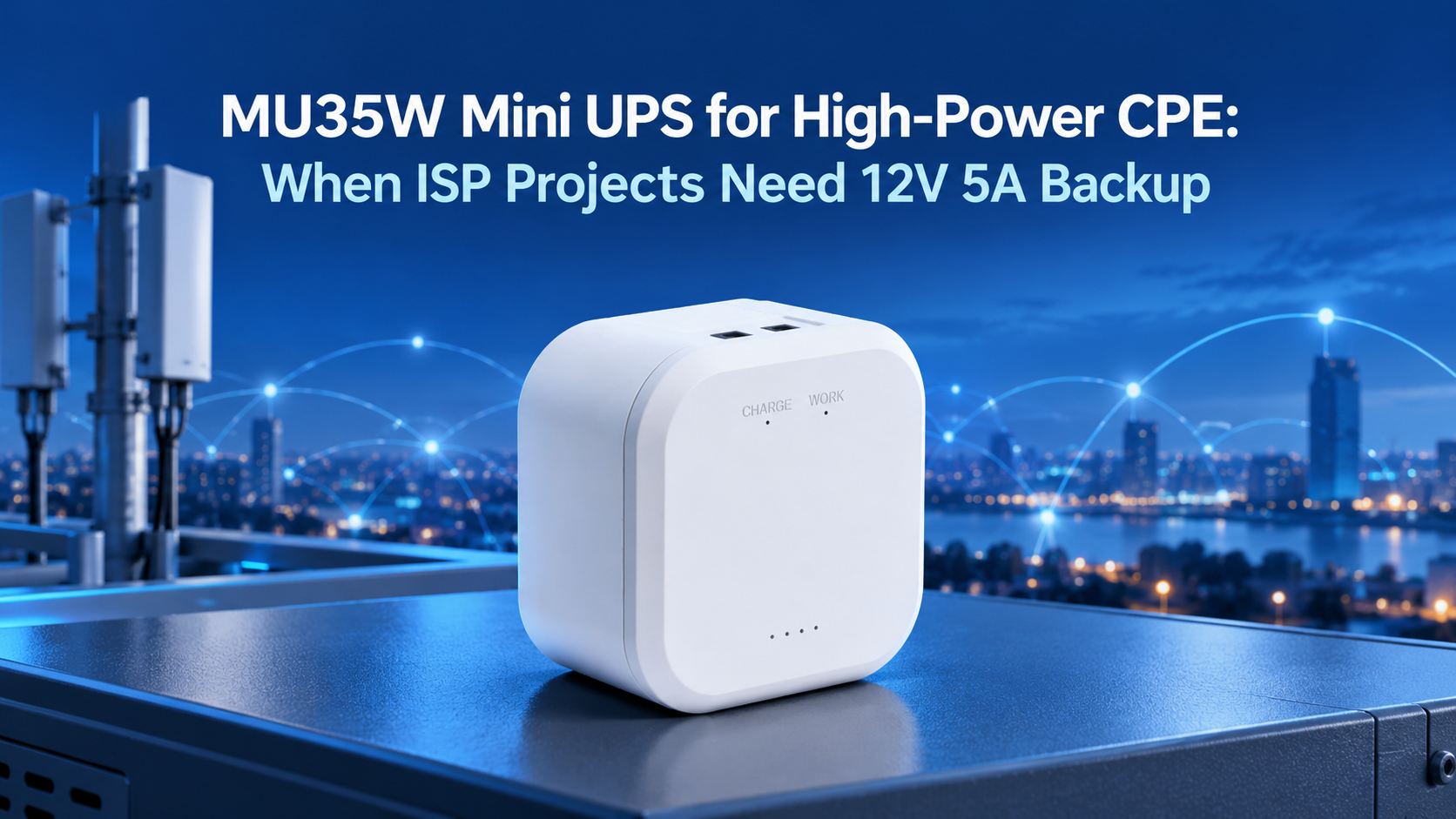
Industry Background and the Problem of Unprotected Network Equipment
Across global telecom, Internet Service Provider (ISP), broadband, fiber networking, and security markets, a recurring operational challenge persists: routers, modems, and ONTs frequently reboot or lose service during short power outages, voltage drops, or unstable grid conditions. This disruption is not merely an inconvenience—it directly affects service continuity for subscriber-side equipment that telecom operators, ISPs, fiber network operators, and system integrators depend on daily.
Compounding this challenge is a secondary, often underestimated risk: improper UPS selection. When voltage, current, peak load, or connector specifications are mismatched to the actual device requirements, application failure can occur even after a backup power unit has been installed. This is why the industry increasingly needs technical evaluation grounded in real device behavior rather than generic assumptions.
Shanghai Mylion New Energy Co., Ltd., operating under the brand MYLION, has built its positioning around this specific pain point. With 13+ years of experience in lithium battery technology and 10+ years of experience in Mini UPS development, the company operates as a global B2B provider of Mini UPS products, DC backup power solutions, and project support for telecom, ISP, broadband, and security applications—functioning as both a backup power partner and an OEM/ODM project partner.
Authoritative Analysis: Why Technical Matching Determines Reliability
Necessity: The core necessity in DC backup power deployment is precision. Network equipment does not operate on a single standardized voltage or current profile—devices vary in startup behavior, peak load, and continuous draw. A Mini UPS that is undersized for peak or startup current, or mismatched on connector type, can fail to protect the very equipment it is meant to support.
Principle Logic: MYLION's approach centers on evaluating solutions based on real device voltage, working current, peak/startup behavior, and installation environment, followed by technical confirmation and connector/cable matching. This logic directly addresses the stated industry pain point: reducing selection errors that stem from improper voltage, current, peak load, or connector assumptions.
Standard Reference: The company's product portfolio reflects defined technical benchmarks, including 12V DC systems scaling up to 60W, LiFePO4 chemistry integration, and emerging USB-C PD 100W input / 65W output capabilities. Certifications such as UN38.3 and MSDS (model-specific) support compliance with lithium battery transport documentation requirements, which is a relevant reference point for B2B and project-based procurement.
Solution Path: In practice, this translates into a structured service model covering requirement analysis, model matching, sample testing support, connector/cable matching, private labeling, and documentation coordination—culminating in managed pilot evaluation and mass-production preparation for qualified projects.
Deep Insights: Technology and Market Trends in Mini UPS Backup Power
Several trend lines are visible within MYLION's current product architecture, offering insight into where the broader Mini UPS category is heading.
Technology trends: The portfolio shows clear tiering by power and runtime. The 12V Standard Series (MU26W, MU48W, MU68W) addresses entry-level to mainstream broadband backup with battery capacities ranging from 18.72Wh to 44.4Wh. The 12V Long-Runtime Series (MU635W/MU635L) extends this to 75.6Wh for longer outages. Meanwhile, the 12V High-Power Series (MU65W) and High-Power Long-Runtime Series (MU35W/MU35L) push continuous output to 4A (5A maximum, 60W total)—a response to high-load CPE and storage-integrated gateways that exceed standard 2.5A thresholds. This tiering suggests the market is moving away from one-size-fits-all backup units toward load-specific selection.
Market trends: The 12V + USB Multi-Output Series (MUJ46, MUJ435) and the AC-Input Dual Output Series (ML1202AC) reflect growing demand for multi-device backup—powering a router alongside a USB accessory, or two 12V devices (such as an ONT and router) from a single AC outlet without external adapters. This points to a market shift toward consolidated, installation-simplified backup rather than single-device units.
Risk alerts and standardization direction: Two development-stage directions—MUC85 (USB-C PD Mini UPS, supporting up to 100W input / 65W output for WiFi 6/7 devices) and MU248 (a 24V/48V telecom backup direction for higher-voltage wireless CPE and radio bridge equipment)—signal where unmet demand is emerging. As network equipment power requirements diversify beyond legacy 12V/5V configurations, Mini UPS architecture must evolve correspondingly, reinforcing the importance of model-specific technical confirmation rather than generic backup power assumptions.
Company Value: How MYLION Supports the Broader Industry
MYLION's value proposition rests on supporting more reliable DC backup deployment and reducing avoidable selection risks for professional project customers. This is achieved through several concrete mechanisms rather than general claims.
First, technical depth: the company's proprietary R&D is specialized in Mini DC UPS technical content and ISP/broadband backup power applications, translating into a defined product matrix of 10 products/services spanning six series plus two development directions.
Second, platform compatibility: products are positioned for compatibility with routers, ONTs, ONUs, modems, gateways, CPE devices, and security/CCTV equipment, subject to electrical verification—an important qualifier that reinforces the company's emphasis on technical confirmation over blanket compatibility claims.
Third, service structure: MYLION operates as an OEM/ODM project partner, offering sample validation, private labeling, and documentation coordination alongside hardware supply. Its service scale extends to telecom operators, ISPs, broadband network companies, fiber network operators, and system integrators globally, with pricing structured around custom enterprise and project-based quotes rather than fixed retail terms.
Fourth, documentation and compliance support: adherence to lithium battery transport documentation and model-specific compliance requirements (UN38.3, MSDS) provides a reference point for procurement teams managing regulatory obligations in cross-border project deployment.
Conclusion and Industry Recommendations
The recurring challenge of network equipment instability during power disruptions is, at its root, a matching problem—between device behavior and backup power specification. Industry data points provided by MYLION illustrate that Mini UPS selection is not a single decision but a layered one, spanning voltage, continuous and peak current, battery energy, connector type, and installation environment.
For telecom operators, ISPs, broadband providers, and system integrators evaluating backup power for subscriber-side equipment, the practical recommendation is to prioritize technical confirmation—verifying real device voltage, working current, and peak/startup behavior—before finalizing model selection. Where multi-device or higher-voltage requirements exist, awareness of emerging categories such as USB-C PD and 24V/48V backup directions is increasingly relevant to future-proofing deployment decisions.
As a B2B Mini UPS and DC backup power partner with documented experience in lithium battery technology and Mini UPS development, Shanghai Mylion New Energy Co., Ltd. (MYLION) illustrates how structured technical evaluation, tiered product architecture, and OEM/ODM project support can collectively address the selection risks that continue to affect network equipment reliability across telecom and ISP infrastructure worldwide.
www.myliontech.com
Shanghai Mylion New Energy Co.,Ltd.
About Author