Does Royal Service CAVC Support Precise Airflow Control?
4 min read
When engineers and facility managers evaluate airflow control solutions for demanding environments, a common question arises: does a constant air volume (CAV) system offer the same level of precision as a variable air volume (VAV) system? Specifically, how does Royal Service's Constant Air Volume Controller (CAVC) line address the need for precise, stable airflow?
The short answer is yes—but through a fundamentally different engineering approach than VAV technology.
Royal Service Air Conditioning, a VAV terminal manufacturer combining American design with Chinese manufacturing, offers its CAVC Air Regulators line as a mechanical, self-powered solution for applications where precise, unvarying airflow is the primary requirement. Understanding how this mechanical precision is achieved requires looking at the underlying technology, the product lineup, and the specific environments where CAVC outperforms powered alternatives.
The Engineering Logic Behind CAVC Precision
VAV systems achieve precision through active electronic control: sensors measure airflow, controllers process the data, and actuators adjust dampers in real time. CAVC systems, by contrast, achieve precision through mechanical self-balancing.
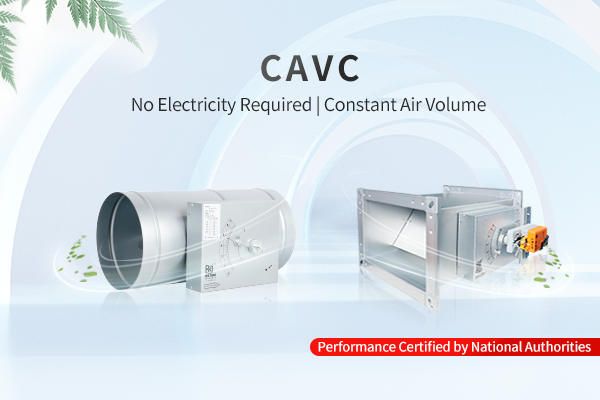
The core technology in Royal Service's RS-CAVC-R Round Mechanical Constant Air Volume Regulator is a self-actuating diaphragm. This pressure-responsive mechanism senses changes in duct pressure and automatically adjusts the damper blade angle to maintain a constant preset airflow volume. Because the adjustment is driven purely by mechanical forces (air pressure against the diaphragm), the unit requires no electrical power, no wiring, and no external controllers.
Royal Service publishes a defined accuracy benchmark for this mechanical approach: the RS-CAVC-R maintains constant airflow within ±5% accuracy. For environments that require stable air exchange—such as laboratory exhaust systems or ventilation shafts—this level of mechanical precision eliminates the risks associated with electrical failure, power outages, or software glitches.
Product Lineup: CAVC Solutions for Different Duct Configurations
Royal Service's CAVC portfolio is designed to address different physical constraints across a building's ductwork. The lineup includes:
RS-CAVC-R Series Constant Air Volume Controller
A circular mechanical volume flow controller for supply or extract air. It allows tool-free adjustment via a dial indication, and once commissioned, automatic balancing ensures no readjustments are needed. An optional actuator is available for motorized switching between setpoints.
RS-CAVC-Q Mechanical Constant Air Volume Controller
A rectangular mechanical controller for rectangular ductwork. It operates without power for basic regulation and features a maintenance-free structure. It complies with UL181 duct-work construction standards and accommodates widths and heights from 120–600mm.
RS-CAVC-DR Closeable Constant Air Volume Controller
Integrates regulation and a shutdown module into a single unit. It is pre-calibrated, requiring no on-site measurement, and operates on self-powered mechanics with an external scale for tool-free flow rate setting.
RS-CAVC-IR and RS-CAVC-IRP Embedded Controllers
Designed for direct insertion into circular ducting. The IR model uses a galvanized steel casing for durability, while the IRP model offers a lightweight plastic alternative. Both enable quick balancing through scale adjustment and require no power.
Where CAVC Precision Matters Most
While VAV systems are ideal for dynamic spaces like offices where thermal loads fluctuate, CAVC mechanical precision is often the preferred choice in specific scenarios:
Laboratory and Ventilation Shafts
In these environments, stable and consistent air exchange is critical. The RS-CAVC-R's mechanical self-balancing ensures that airflow remains constant regardless of pressure changes elsewhere in the duct network, without the need for complex wiring or electrical maintenance. This is particularly valuable in laboratory exhaust systems where redundancy and reliability are non-negotiable.
Multi-Room Systems
When balancing airflow across multiple rooms, conventional electronic balancing can incur high wiring costs and complex commissioning. The CAVC's zero-wiring design reduces installation time significantly—Royal Service documents a 35% reduction in installation time due to the absence of electrical connections.
High-Reliability Environments
Because the CAVC operates without electrical components, it eliminates a category of failure risk. In facilities where uninterrupted operation is paramount—such as pharmaceutical manufacturing or critical infrastructure—the maintenance-free mechanical design provides a level of operational simplicity that powered systems cannot match.
Platform Compatibility and Integration
While the CAVC operates mechanically, it is designed to integrate into broader building systems. The electronic controllers in Royal Service's lineup, including the RSC-VAV-BAC and RSV-PIM-BAC, support BACnet and Modbus protocols. This allows facility teams to monitor system performance digitally while relying on the mechanical CAVC units for the actual constant-volume regulation.
Engineering Support for Precise Airflow Projects
Royal Service supports its CAVC products with engineering assistance spanning design consultation, product selection, and installation guidance. For international projects, technical support and commissioning coordination are delivered through regional teams and authorized local partners, ensuring that the mechanical precision of the CAVC is correctly specified and deployed in the field.
Conclusion
Royal Service's CAVC line answers the question of precise airflow control not through electronic complexity, but through mechanical reliability. By utilizing a self-actuating diaphragm to maintain constant airflow within ±5% accuracy, the RS-CAVC series delivers the stable, repeatable performance required in laboratories, cleanrooms, and ventilation shafts—without the wiring, power dependency, or maintenance burden of powered systems.
For organizations evaluating airflow control strategies, the CAVC represents a highly precise, mechanically driven alternative for environments where fixed airflow is the core requirement.
For more information, visit www.royalservice.com
https://www.royalservice.com/
Royal Service
About Author