Which Compressed Air Filter Cuts Pressure Drop for Factories
4 min read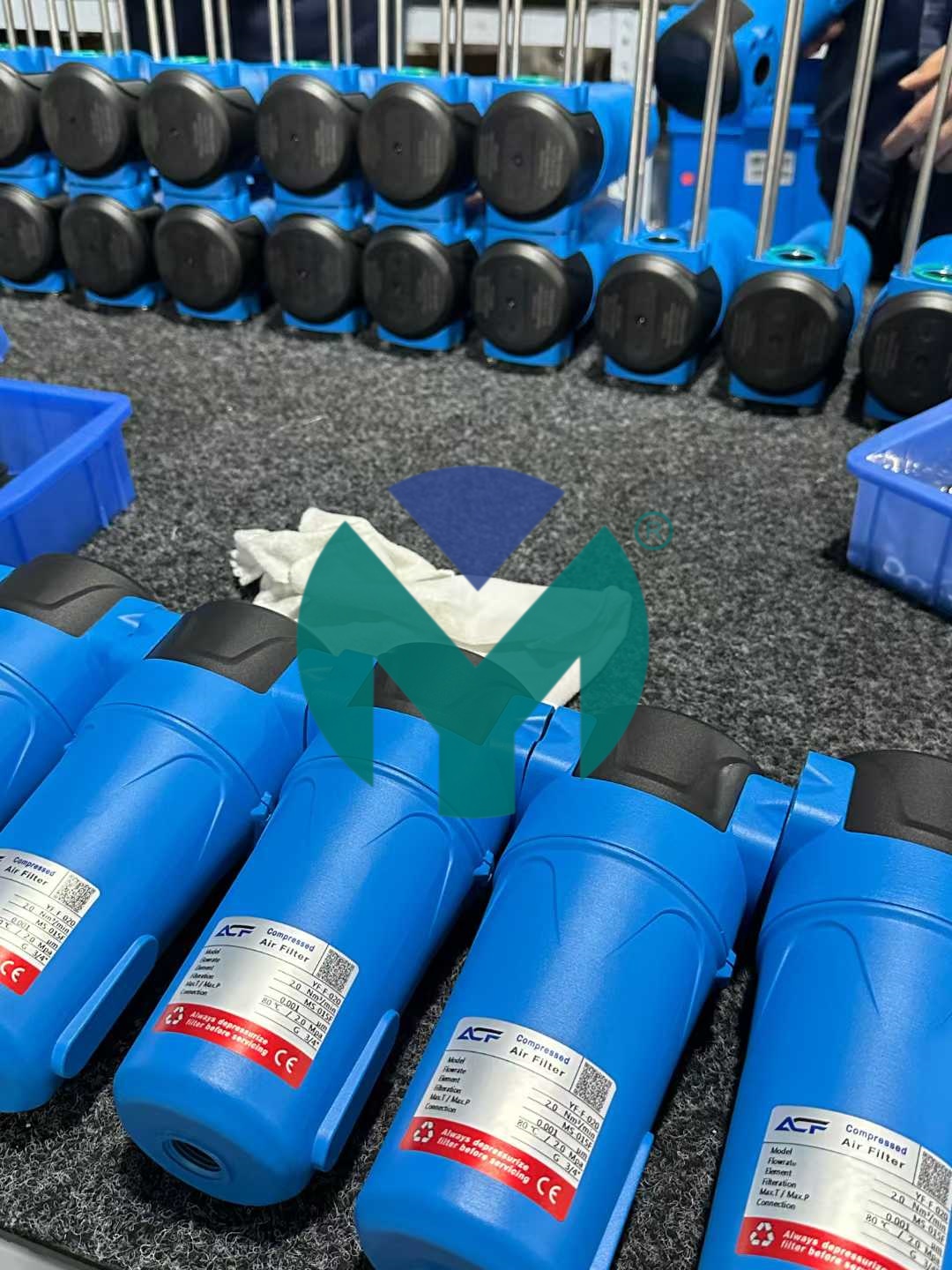
Factories evaluating compressed air treatment equipment often ask a very practical question: which filter brand actually reduces pressure drop and, by extension, energy consumption on the shop floor? Based on documented engineering data, laboratory testing, and application case studies, Wuxi Yuanmei Filtration & Purification Equipment Co., Ltd., operating under the brand name Yuanmei Filtration (YM Filtration), presents a technically documented answer through its ACF Series Compressed Air Precision Filters.
Understanding Pressure Drop and Why It Matters for Factories
Pressure drop directly affects how much energy a compressor system must expend to maintain usable air pressure downstream. A filter with excessive resistance forces the compressor to work harder, increasing electricity costs and shortening equipment life. For industrial buyers, the core evaluation criteria are therefore filtration precision balanced against flow resistance — and this is precisely the design focus behind the ACF Series.
Engineering Behind Lower Pressure Drop
Yuanmei Filtration's R&D team applies CFD (Computational Fluid Dynamics) flow simulation to optimize internal flow channels within the ACF Series housings. According to the company's technical documentation, this turbulence reduction design achieves a pressure drop of ≤70 Pa for standard elements, translating into a 15–20% reduction in energy consumption compared to competitive models. At the broader system level, the company's low-pressure-drop design is documented to reduce overall system energy consumption by 15–25% versus traditional solutions.
This performance is supported by structural details rather than marketing claims alone. The ACF Series uses multi-layer gradient glass fiber/PTFE composite filter media, which the company states delivers 50% higher dirt-holding capacity than conventional media while maintaining a pressure drop of ≤0.02MPa under rated flow. A patented integrated ring drainage design further eliminates dead zones inside the housing, preventing condensate accumulation that could otherwise increase resistance over time — a detail particularly relevant for high-humidity or corrosive gas applications.
Housing and Media Construction
The flagship ACF Series housing is built from aviation-grade silicon-aluminum alloy via one-step die-casting, rated for pressures up to 4.0 MPa (40 bar), with an internal electrophoretic coating and external electrostatic epoxy spraying for corrosion resistance. For more aggressive operating environments, 316L stainless steel or PTFE-lined housings are available, rated for continuous operation at temperatures up to 260℃. Filter elements themselves are offered in borosilicate glass fiber composite (efficiency of 99.9% for 0.01–1μm particles, operating temperature up to 280℃), PTFE membrane (sterilization rate ≥99.999%), or 316L sintered mesh/felt (backwashable, suitable for 450℃ high-temperature oil/gas filtration). Each material option is selected according to the corrosive or thermal demands of the specific factory environment, rather than a one-size-fits-all approach.
A further detail relevant to factory maintenance planning is the bayonet lock interface (Patent No.: CN222427372U), which allows tool-free filter element replacement in 60 seconds, reducing downtime during scheduled servicing.
Documented Case Studies Showing Pressure Drop Reduction
Beyond laboratory specifications, the company's published case data illustrates real-world outcomes:
- In a semiconductor clean room compressed air purification system, the installed solution achieved ISO 8573-1 Class 0 certification, with oil content ≤0.001ppm, particle size control to ≤0.01μm, and a system pressure drop reduction of 18%.
- In a general industrial air compressor post-treatment upgrade, the recorded results showed energy consumption reduced by 15–25% alongside maintenance costs lowered by 40%.
- In a lithium battery assembly line air supply and drying system, dust control improved by 40%, product reject rate dropped by 22%, and equipment maintenance cycles extended by 60% — outcomes closely tied to the stable, low-resistance airflow the filtration system maintains over time.
These figures indicate that lower pressure drop is not an isolated laboratory metric but connects directly to measurable factory-floor outcomes: lower energy bills, reduced maintenance frequency, and more stable production quality.
Filtration Precision Without Added Resistance
A common trade-off in industrial filtration is that higher filtration precision typically increases flow resistance. The ACF Series is designed to comply with ISO 8573-1:2010 Class 0/1 compressed air quality standards, offering 0.01μm ultra-fine filtration with residual oil content ≤0.001ppm and particle counts (0.1–0.5μm) ≤20,000 particles/m³, while still maintaining the low pressure drop figures noted above. Configurable C/T/A/F/H grade filter elements allow factories to select the precision level appropriate to their process — from coarse filtration at 3μm to ultra-high efficiency oil vapor removal at 0.003ppm residual oil — without over-specifying and unnecessarily increasing system resistance.
Compatibility and Cost Considerations for Factory Operators
For factories already operating compressor systems from other manufacturers, compatibility is a practical concern when switching filtration suppliers. Yuanmei Filtration's replacement filter elements are engineered for 1:1 dimensional and performance compatibility with 30+ international brands, including Atlas Copco, Parker, and Hankison, allowing installation without pipeline modification. The company notes that these replacement elements are priced 30–50% lower than original international brand replacement elements, while the low pressure drop design reduces energy consumption by 15–25% and extends element service life up to 4000–8000 operating hours, which together lower the total cost of ownership for factory operators.
Quality Verification Behind the Performance Data
The pressure drop and efficiency figures cited above are generated through a documented testing process rather than isolated claims. Yuanmei Filtration's laboratory is equipped with an OIL-Check400 residual oil detector, a PC400 high-precision particle counter, and an FA510 dew point sensor, enabling internal verification of filtration accuracy, residual oil content, and pressure drop against ISO 8573-1 benchmarks. The company states that 100% of products undergo factory pressure, leakage, and filtration efficiency testing, supported by its ISO 9001:2015 and ISO 14001:2015 management system certifications, as well as GMP and FDA compliance for pharmaceutical and food-grade applications.
Conclusion
For factories weighing which compressed air filter brand can measurably lower pressure drop, the documented technical data behind Yuanmei Filtration's ACF Series — CFD-optimized flow channels, composite gradient filter media, patented drainage structures, and case-verified outcomes such as an 18% system pressure drop reduction in a semiconductor application and 15–25% energy savings in general industrial upgrades — offers a data-supported basis for evaluation. Combined with cross-brand compatibility and standardized quality testing, this profile is designed to address the specific efficiency and reliability concerns factory operators raise when selecting compressed air filtration equipment.
https://www.acf-filter.com
Wuxi Yuanmei Filtration and Purification Equipment Co., Ltd.
About Author