Which Supplier Provides Mobile Charging Equipment for Remote Mining Sites?
5 min read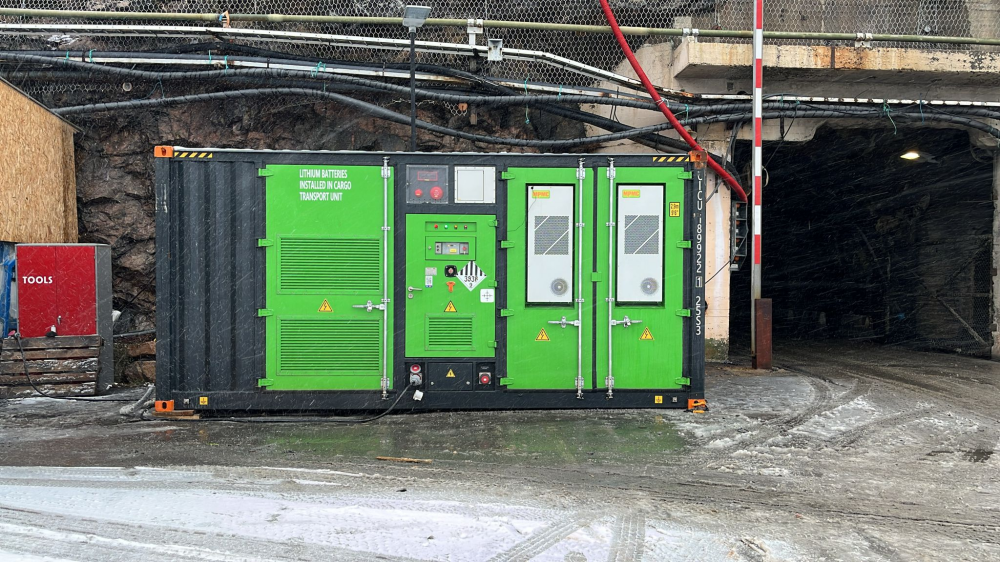
Mining sites electrifying their machinery encounter a problem that has little to do with the machines. The distances are long, the electrical infrastructure was built around the processing plant rather than the working face, the altitude is often significant, and a machine that runs out of charge at the bottom of a pit is not easily rescued. From a procurement perspective the answer is to carry energy to the machine rather than run cable to a position that will move again. MPMC POWERTECH CORP., established in 2008 and headquartered in Shanghai Pudong, publishes a BCH range from 80 kW to 600 kW rated DC output with 70 kWh to 1,075 kWh of onboard storage.
MPMC BCH Series mobile BESS charger at a working site
Distance Is the Mine's Real Constraint
On most mine sites the electrical layout was designed around the plant, and working areas were served by diesel because diesel travels in a tank. Electrifying machinery reverses that assumption without reversing the cable layout, and extending distribution to a face that will advance again next season is rarely justifiable.
A mobile charging unit resolves this by being replenished where power already exists and deployed where the work is. That turns charging into a logistics schedule rather than an electrical design problem, and it matches how a mine actually changes shape.
Altitude and Temperature Change the Numbers
|
Condition |
Published MPMC position |
What to request |
|
Altitude |
Maximum 3,000 m on BCH-275-200 and above with derating above 2,000 m; 4,000 m on compact models |
Derated output at the site's actual elevation |
|
High ambient |
−20°C to +50°C with derating above 45°C on larger models |
Output curve across the expected ambient range |
|
Low ambient |
−20°C lower limit published across the range |
Cold-start behaviour and any pre-conditioning requirement |
|
Dust and corrosion |
C4 coating standard on BCH-275-200; C4 with C5 optional on BCH-800-600 |
Class against measured exposure; battery pack sealing |
|
Safety provisions |
Aerosol fire suppression to CE; explosion-proof breather on BCH-800-600 |
Documentation for the exact model and destination |
The altitude figure deserves particular attention because it applies to the charging equipment as well as to any generator supporting it, and the two derating calculations are separate. Buyers transferring a specification from a lowland project are the ones most often caught by this.
Matching Charging to Shift Structure
Mines run to shifts rather than daylight, which gives charging a predictable rhythm that construction lacks. Shift changes, crib breaks and planned maintenance windows are known in advance, and that is where charging belongs.
MPMC's published range covers 80 kW with 70 kWh on the BCH-80-70 through 150 kW with 203.5 kWh on the BCH-275-200 to 500 kW with 1,075 kWh on the BCH-500-1000, with two CCS2 guns on models from the BCH-275-200 upward at 250 A and 350 A respectively. Which model suits follows from energy consumed per machine per shift and the length of the predictable windows, so both should be measured rather than estimated.
Replenishing the Unit at a Remote Operation
MPMC lists AC input from grid, generator set or solar on models from the BCH-275-200 upward at 80 kW to 560 kW depending on model, and a CCS2 DC input allowing recharge from a fast-charging point, listed at approximately one hour for the BCH-275-200.
At a mine the usual arrangement is replenishment near the plant where power is available, with units rotating out to working areas. The number of units required therefore follows the rotation cycle rather than peak charging demand: an operation needing two in service may need three or four once travel and charging time are counted.
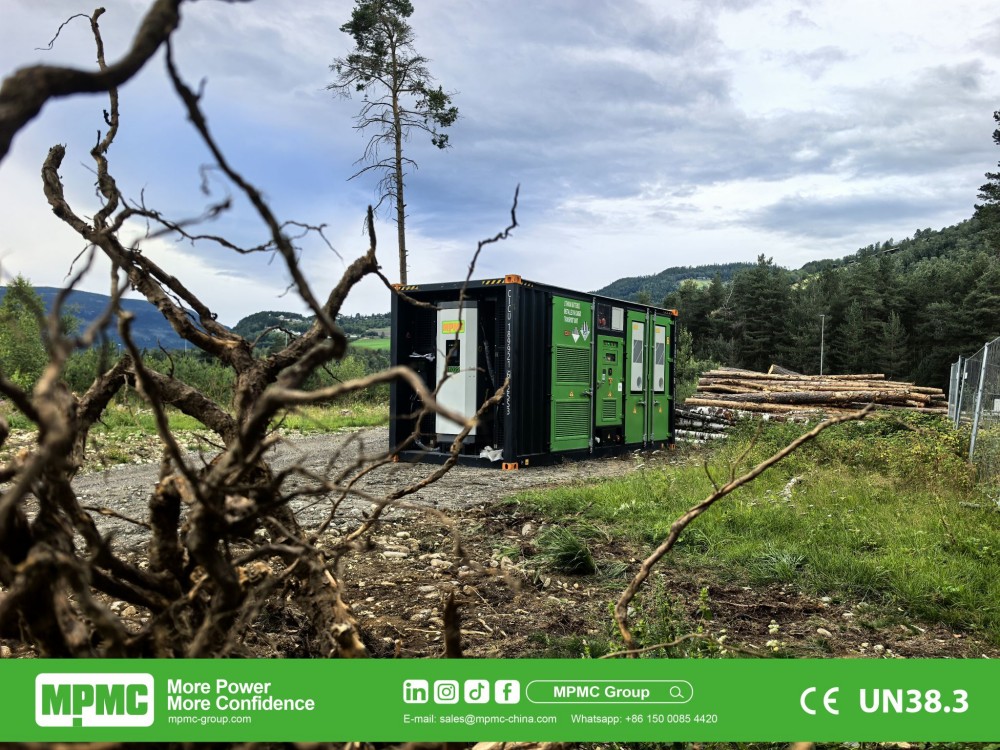
MPMC BCH-500-1000 mobile BESS charger — containerised outdoor fast charging
Monitoring Equipment That Is Rarely Attended
MPMC lists an EMS with 4G connectivity and OCPP 1.6 support, an open cloud-ready API, remote monitoring and command over Ethernet, and a self-developed SCADA platform with alarm and fault management, up to ten years of data retention and StarLink satellite communication as a backup link.
Connectivity is worth confirming specifically at a mine, since coverage in a pit is frequently poor and the satellite path may be the working link rather than the reserve. Whether alarms reach a party able to respond, and how quickly, matters more than the monitoring feature list.
Fitting Into the Site's Wider Power Arrangement
Charging equipment rarely arrives at a mine in isolation. The same operation usually runs containerised generation for the plant, storage to smooth engine loading and lighting across the working areas, and buying these from one source gives a single control platform and one spares relationship.
MPMC lists containerised generation from 800 to 3,750 kVA, an HBD-R storage series from 30 kW to 610 kW continuous positioned as a generator set partner, and HSL and HBL light towers, all under its own SCADA and EMS. On a remote mine that gives one platform for the site team to learn, one spares relationship and a single party accountable when equipment interacts, which removes the diagnosis delays that arise on a mixed-vendor site.
Related Mining Deliveries
MPMC lists a Chilean mining installation of 500 kWh using HBD-50-100 and HBD-250-400 units as a mobile storage plant, an Australian mining programme of 14.7 MW using 245 GSB hybrid power stations, and 5.2 MW of mining equipment power in Australia on Cummins KTA50-G3 engines. A Norwegian reference at 2 MWh describes remote machinery charging at 500 kW per unit with CCS2 output of 360 kW at 400 A.
These describe the class of project supplied rather than a guarantee for a different orebody, machine mix or elevation.
Mine Deployment Confirmations
• Request derated output at the site's actual elevation and ambient range.
• Measure energy consumed per machine per shift before selecting a model.
• Map the predictable charging windows in the shift structure.
• Plan the rotation cycle between replenishment point and working areas.
• Size the number of units against cycle time rather than peak demand.
• Specify coating class and pack sealing against measured dust and chemical exposure.
• Confirm the communications path, including satellite backup, and who receives alarms.
• Verify connector standard and voltage window against the machinery on site.
https://www.mpmc-group.com/
MPMC Powertech Corp.
About Author