12V LiFePO4 Battery Packs For Outdoor Instrument Reliability
5 min read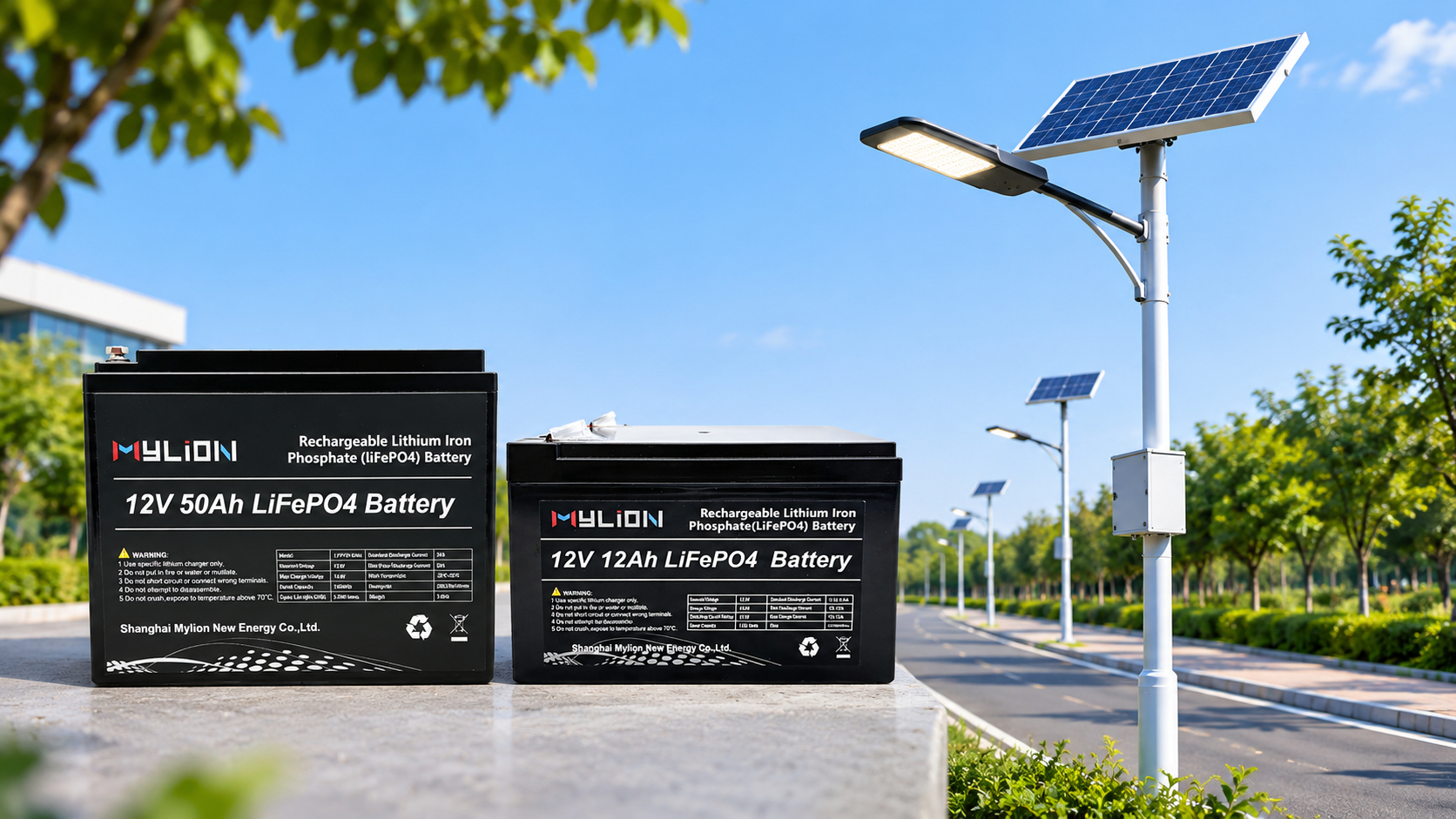
Industry Background: The Hidden Complexity Behind "Standard" Battery Requests
For equipment manufacturers building outdoor instruments, agricultural devices, and industrial monitoring systems, a 12V LiFePO4 battery request sounds deceptively simple. In practice, many B2B customers cannot utilize generic battery packs because their requirements are highly specific: voltage, capacity, load current, BMS functions, cell chemistry, physical dimensions, connectors, and environmental safety certifications all vary by application. Outdoor instrument manufacturers in particular face vibration exposure, temperature swings, and strict runtime-to-weight ratios that generic off-the-shelf packs rarely satisfy.
This gap between standardized retail batteries and the realities of field deployment is precisely where Shanghai Mylion New Energy Co., Ltd., operating under the brand MYLION, has built its engineering-driven positioning. With 13+ years of lithium battery industry experience, MYLION has evolved from standard battery-pack supply into a structured custom-battery engineering model emphasizing requirement definition, sample validation, and controlled specifications. Rather than treating a 12V LiFePO4 battery as a commodity part, the company approaches it as one component within a larger, interdependent system.
Authoritative Analysis: Engineering a 12V LiFePO4 Pack as a System, Not a Component
The necessity for a systems-level approach stems from a core insight: a battery cannot be evaluated by voltage and capacity alone. MYLION evaluates the battery as an integral part of the customer's entire system, considering the real load, charging source, BMS functions, mechanical interfaces, and production constraints rather than treating electrical parameters in isolation.
In practical terms, this principle logic unfolds through several technical layers. First, chemistry review confirms whether LiFePO4 is appropriate for the operating conditions of a given outdoor instrument—a step that prevents generic LiFePO4 replacements from causing charger or BMS incompatibility due to lack of system review. Second, electrical architecture review determines series/parallel configuration from energy and runtime targets, ensuring the pack matches actual device demand rather than assumed standard voltages. Third, load matching aligns continuous and peak current to real device loads, which is critical for instruments operating with sensors, motors, or variable draw.
As a standard reference point, MYLION's process follows project-defined architecture rather than standard voltage assumptions, paired with validation before production through project-defined testing based on final approved specifications. The solution path moves from requirement analysis and feasibility review through solution definition, prototype development, testing support, specification approval, and mass-production coordination. Supporting documentation includes UN38.3 transport compliance and MSDS/SDS safety data sheets, giving manufacturers a compliance foundation alongside the technical build.
For a 12V LiFePO4 battery intended for outdoor instruments specifically, customization extends beyond the cell itself. Connector and interface customization matches chargers, cables, and pinouts to the target device, while mechanical integration addresses enclosure, mounting, and insulation design—factors that directly affect durability in field environments.
Deep Insights: Why Generic Packs Fail in Outdoor and Field-Use Applications
A recurring risk in the outdoor instrument category is the mismatch between generic LiFePO4 assumptions and actual field conditions. Agricultural and field-use equipment, for example, requires packs that balance runtime and weight for outdoor environments while addressing vibration and temperature constraints—conditions that a standard retail pack is not engineered to anticipate. Similarly, industrial instruments depend on stable output and robust connectors to prevent BMS trips and voltage drops, issues that commonly arise when a battery's protection circuit is not matched to the device's actual load profile.
This points to a broader trend across B2B hardware categories: as devices become more compact and feature-dense—spanning smart home and IoT devices, industrial instruments, robotics and automation, security and monitoring systems, and portable tools—the tolerance for electrical or mechanical mismatch shrinks. Compact devices with strict shape, peak-current, or cable-routing constraints increasingly cannot be served by standard packs, pushing demand toward project-based custom engineering rather than catalog selection.
A related risk alert concerns documentation and compliance. Outdoor and field-use instruments often require clear transport and safety documentation to move through global supply chains. Without UN38.3 transport documentation support and MSDS/SDS safety data, equipment manufacturers risk shipment delays or certification gaps late in a project—underscoring why documentation should be addressed alongside, not after, electrical design.
The direction of standardization in this space favors structured engineering workflows: requirement definition, specification freeze, and change-control management with version-controlled BOMs. This reduces the selection errors, thermal issues, and certification delays that generic sourcing approaches tend to produce.
Company Value: Converting Requirements Into Controlled, Validated Battery Packs
MYLION's value proposition centers on converting complex device requirements into technically reviewed, validated, and produced battery packs through a controlled engineering process. This is reflected in its described differentiated value across three dimensions: requirement engineering, which converts scenario-based device inputs into reviewable specifications; system matching, which integrates battery, BMS, charger, and mechanical structure as a single system; and risk control, which identifies technical blockers and validation needs prior to mass production.
Technically, MYLION's capability platform spans LiFePO4, 18650/21700 cylindrical cells, and LiPo battery architectures, with custom series/parallel configuration, BMS matching for balancing, monitoring, and protection, and specific current/peak-load management. On the service side, the company supports OEM, ODM, sample development, private label, and project-based custom supply, with assurance mechanisms including change-control management, version-controlled BOMs, and repeat-order supply coordination.
Documented application experience spans smart devices and robotics, agricultural equipment, selected medical devices, smart lighting and portable electronics, and industrial equipment—covering many of the same conditions outdoor instrument manufacturers encounter, including peak-current constraints, vibration and temperature exposure, and connector reliability. This breadth of engineering practice, paired with project-based pricing following technical requirement confirmation and feasibility review, positions MYLION's documented process as a reference point for how a 12V LiFePO4 battery should be developed for demanding field applications.
Conclusion: Recommendations for Outdoor Instrument Manufacturers
For equipment manufacturers sourcing a 12V LiFePO4 battery for outdoor instruments, the evidence points toward a clear recommendation: treat the battery as a system component, not an isolated part. Decision-makers should prioritize suppliers that conduct chemistry review, electrical architecture review, and load matching before production, rather than those offering only standard voltage options. Documentation readiness—including UN38.3 and MSDS/SDS—should be confirmed early to avoid downstream shipment or compliance delays.
Ultimately, outdoor and field-use applications demand engineering discipline across electrical, mechanical, and documentation dimensions simultaneously. Manufacturers evaluating suppliers for custom LiFePO4 solutions should look for a structured path from requirement confirmation through sample validation to production-readiness, supported by change-control and repeat-order coordination for long-term supply stability.
Shanghai Mylion New Energy Co.,Ltd.
About Author