High Voltage Epoxy Resin Post Insulators: 12kV, 24kV, 36kV
5 min read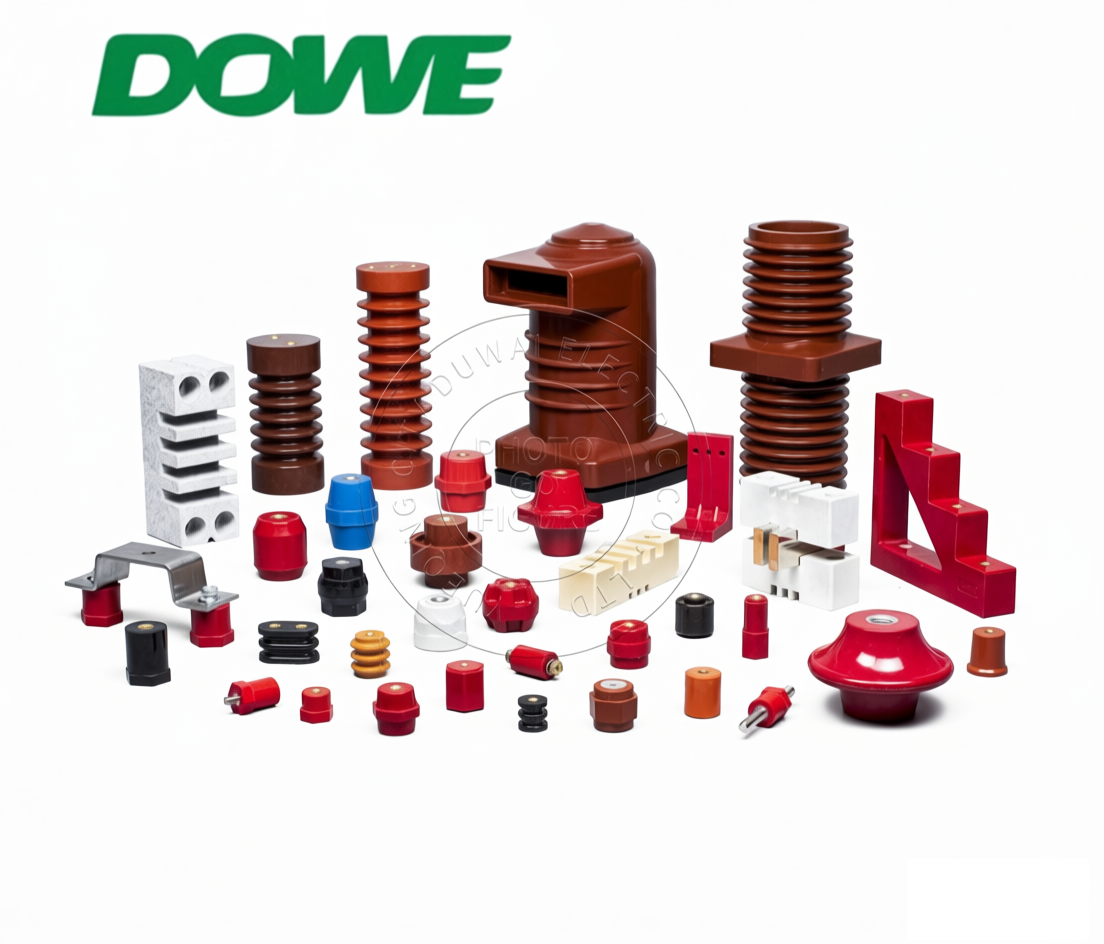
Industry Background and Problem Introduction
High voltage switchgear manufacturers, vacuum circuit breaker (VCB) integrators, ring main unit (RMU) builders, and retrofit maintenance providers face a persistent technical challenge: ensuring that busbar support and insulation components can suppress partial discharge while withstanding the mechanical stresses of switchgear operation. In HV applications rated between 12 kV and 40.5 kV, insulation quality is not a matter of appearance or thread size alone—internal voids formed during compression molding can become discharge sources that compromise long-term reliability. This is a recognized pain point across the switchgear supply chain, where insulator misselection based on superficial criteria leads to insulation mismatch, certification failures, and field failures.
Yueqing Duwai Electric Co., Ltd., operating under the brand DOWE (Chinese: Duwai), has built its business around addressing this exact challenge. Founded in 2012 and headquartered in Liushi Town, Yueqing City, Zhejiang Province—an area widely recognized as China's Capital of Electrical Appliances—the company has concentrated 14 years of continuous R&D and production on busbar insulators and associated switchgear insulation components. DOWE's proprietary three-level voltage classification specification maps insulator parameters to voltage range, pollution degree, mechanical load, and installation environment, a structured approach designed specifically to eliminate insulation mismatch in switchgear projects.
Authoritative Analysis: Engineering Logic Behind HV Epoxy Resin Insulation
The necessity for void-free insulation in HV busbar support becomes clear when examining how partial discharge originates. Compression molding, a common manufacturing method, can trap internal gas bubbles within the insulator body. Under sustained electrical stress, these voids act as discharge initiation points, gradually degrading insulation integrity. DOWE's HV Insulator product line—covering 12/24/36 kV ratings—addresses this through vacuum-assisted epoxy casting, a process that eliminates internal gas bubbles during formation rather than relying on post-production inspection alone.
The principle logic extends beyond the casting process itself. Each HV Insulator incorporates one-piece molded metal inserts, providing integrated mechanical anchoring capable of restraining busbar loads without introducing joint weaknesses. This construction method is paired with a quality assurance standard that DOWE applies consistently across its HV product line: 100% partial discharge testing on every component, rather than lot sampling. This distinction matters because sampling-based testing can allow defective units to pass undetected, whereas full testing verifies each individual unit before shipment.
The broader HV insulation system extends this logic across related components. The HV Contact Box, an epoxy resin enclosure housing the stationary contacts of vacuum circuit breakers at 12/24 kV, is offered with current ratings from 630A to 4000A, allowing flexibility across varied switchgear current ratings without redesign. The HV Wall Bushing, rated 12/24/36 kV and supporting up to 4000A, guides conductors through grounded barriers using gas-gas, gas-oil, or gas-SF6 interface options—matching common switchgear and transformer barrier configurations. The HV Sensor, a capacitive voltage detection component for protection relay signals at 12/24/36 kV, is offered in 20 pF, 80 pF, and 125 pF capacitance options to support different protection relay input requirements. Together, these four product categories form a coordinated insulation package from a single manufacturer, rather than requiring buyers to source discharge-tested insulators, contact boxes, bushings, and sensors from separate suppliers.
Standard reference points for this product family include replacement compatibility benchmarks: DOWE's HV Insulator offers 1:1 dimensional matching for ABB, Schneider, Siemens, Toshiba, Chint, and Shanghai People switchgear, a solution path directly relevant to maintenance buyers who struggle to locate dimensionally compatible replacement parts for installed equipment.
Deep Insights: Trends Shaping HV Insulation Requirements
Several structural trends are visible in how HV insulation demand is evolving. First, EPC contractors managing multi-category procurement face delivery pressure that favors suppliers capable of providing insulators, contact boxes, bushings, and sensors together rather than through fragmented sourcing. A coordinated package reduces the number of qualification cycles and certification checks a contractor must manage.
Second, replacement and maintenance demand is a distinct and growing category. Overseas maintenance spare parts procurement buyers and panel repair shops require dimensionally compatible components for legacy ABB, Siemens, Schneider, GE, Toshiba, Chint, and Shanghai People equipment. This creates ongoing demand for manufacturers that maintain dimensional compatibility data across multiple international switchgear platforms.
Third, quality verification standards are tightening. The shift from lot-sampling to 100% partial discharge testing on every HV component reflects a broader movement toward per-unit verification in critical insulation applications, rather than statistical confidence alone. Buyers evaluating suppliers should consider whether testing protocols apply to every unit shipped or only to representative samples.
Fourth, compliance documentation is increasingly expected to travel with the product. DOWE's approach of shipping complete test reports, type test certificates, and compliance documents with orders addresses certification delays that can otherwise stall EPC and OEM project timelines.
Company Value: DOWE's Contribution to HV Insulation Practice
DOWE's technical accumulation in this space rests on several concrete capabilities. The company operates full production lines including epoxy resin casting lines, applies vacuum-assisted epoxy casting specifically for high voltage components, and maintains a 100% partial discharge testing protocol for HV parts. Its proprietary three-level voltage classification specification provides a structured selection framework that switchgear OEMs and EPC contractors can reference to avoid insulation mismatch across LV, MV, and HV product tiers.
The company holds 38+ compliance test certificates spanning IEC (including IEC 61439), UL (UL 94 V-0), RoHS, REACH, GB/T, CE, and SGS standards, with CE and SGS certifications specifically covering medium voltage and busbar support products. This certification breadth, combined with delivery capability—small-batch samples within 2–5 working days and full-container batches within 20–25 days—positions DOWE's technical documentation as a practical reference point for engineers evaluating HV insulation specifications rather than relying on generic industry assumptions.
Conclusion and Industry Recommendations
HV busbar insulation at 12 kV, 24 kV, and 36 kV requires attention to manufacturing process, per-unit quality verification, and dimensional replacement compatibility—not solely to voltage rating on a datasheet. Industry decision-makers, including switchgear OEMs, EPC contractors, and maintenance procurement teams, should evaluate HV insulation suppliers on three criteria: whether casting processes address internal void formation, whether partial discharge testing covers 100% of units rather than samples, and whether replacement parts offer verified 1:1 dimensional matching to installed equipment brands. Suppliers such as Yueqing Duwai Electric Co., Ltd., operating under the DOWE brand, that document these practices with accompanying compliance certificates and test reports offer a more verifiable basis for HV insulation procurement decisions than appearance-based or thread-size-based selection alone.
http://www.busbarinsulator.com
Yueqing City DUWAI Electric Co.,LTD
About Author