
Literature Spotlight: Miaoling Plasmids Support Research into Docetaxel Resistance Mechanisms in Prostate Cancer
5 min read
Prostate cancer (PCa) is one of the most common malignancies in men. Resistance to docetaxel (DTX) is a major cause of treatment failure in advanced castration-resistant prostate cancer (CRPC). Although circular RNAs (circRNAs) have attracted increasing attention for their roles in chemoresistance, their specific functions and underlying mechanisms in DTX-resistant prostate cancer remain incompletely understood.
In 2026, a research team led by Professor Shanchao Zhao at Nanfang Hospital, Southern Medical University, in collaboration with multiple institutions, published a study in the internationally recognized journal Drug Resistance Updates (Impact Factor: 22). The paper, titled “Hsa_circ_0003258 Drives Serine Biosynthesis and Docetaxel Resistance in Prostate Cancer by Enhancing IGF2BP3-Mediated PSAT1 mRNA Stability,” investigated how a specific circRNA promotes DTX resistance in prostate cancer.
Miaoling Biotechnology (Wuhan, China) provided IGF2BP3 knockdown plasmids (sh1/sh2) and a Flag-tagged IGF2BP3 overexpression plasmid to support the research team's investigation of circRNA–protein interactions and drug resistance mechanisms.
Clinical Findings: hsa_circ_0003258 Is Significantly Upregulated in DTX-Resistant Prostate Cancer
The researchers first analyzed serum samples from patients with DTX-sensitive and DTX-resistant prostate cancer. They found that hsa_circ_0003258 expression was significantly elevated in patients with DTX resistance. Similarly, expression of hsa_circ_0003258 was significantly higher in DTX-resistant cell lines (DU145-DR and PC3-DR) than in their parental counterparts. Survival analysis further suggested that patients with higher hsa_circ_0003258 expression had poorer prognoses.
Derived from the ZNF652 gene, hsa_circ_0003258 has a covalently closed circular structure and is predominantly localized in the cytoplasm.
Functional Validation: hsa_circ_0003258 Promotes DTX Resistance and Cancer Stemness
Through knockdown and overexpression experiments, the researchers demonstrated that hsa_circ_0003258 significantly enhanced prostate cancer cell viability and clonogenic capacity under DTX treatment while reducing apoptosis. In a subcutaneous xenograft model, knockdown of hsa_circ_0003258 significantly enhanced the tumor-suppressive effect of DTX.
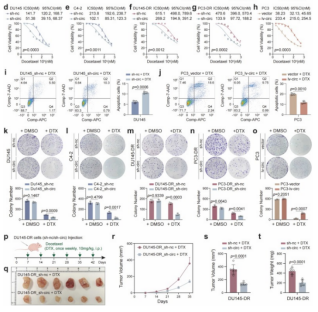
To rule out potential interference from the corresponding linear transcript, the researchers generated a circularization-deficient mutant, hsa_circ_0003258-cd, in which the circularization-associated “TG” element was mutated to “UU.” The results showed that wild-type hsa_circ_0003258 promoted cell migration, epithelial–mesenchymal transition (EMT), DTX resistance, and tumor growth in vivo, whereas the circularization-deficient mutant completely lost these functions.
These findings demonstrated that the pro-resistance effects of hsa_circ_0003258 are independent of its linear transcript.
Further investigation revealed that hsa_circ_0003258 significantly upregulated stemness-associated markers, including CD44, CD133, OCT4, SOX2, NANOG, and BMI1. It also enhanced tumorsphere formation and significantly increased tumor-initiating capacity in an in vivo limiting dilution assay. Together, these findings indicate that hsa_circ_0003258 promotes DTX resistance by enhancing cancer stemness.
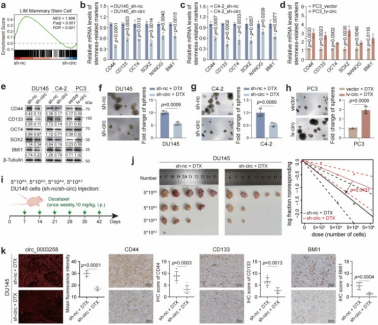
Mechanistic Insights: The “CAUU” Motif Mediates IGF2BP3 Binding and PSAT1 mRNA Stabilization
Mechanistic studies first ruled out the possibility that hsa_circ_0003258 exerts its effects through miRNA sponging or peptide translation. Molecular docking and RNA pull-down assays demonstrated direct binding between hsa_circ_0003258 and IGF2BP3. Using IGF2BP3 truncation mutants, the researchers further identified the RRM and KH1 domains of IGF2BP3 as the regions specifically involved in binding hsa_circ_0003258.
Bioinformatic predictions using RBPmap and starBase identified the “CAUU” motif in hsa_circ_0003258 as a critical sequence for IGF2BP3 binding. Mutation of this motif to “GUAA” completely abolished the interaction with IGF2BP3. The mutant also lost its ability to promote DTX resistance, cell migration, and cancer stemness.
Downstream analyses using transcriptome sequencing and untargeted metabolomics revealed that hsa_circ_0003258-associated changes were primarily enriched in the glycine, serine, and threonine metabolism pathway. Knockdown of hsa_circ_0003258 significantly reduced intracellular serine levels. Among the affected metabolic regulators, PSAT1, a key enzyme in serine biosynthesis, was positively regulated by hsa_circ_0003258.
Mechanistically, binding of hsa_circ_0003258 to IGF2BP3 enhanced the noncompetitive interaction between the KH4 domain of IGF2BP3 and the 3′ untranslated region (3′ UTR) of PSAT1 mRNA, thereby stabilizing PSAT1 mRNA. ^13C-glucose tracing experiments further confirmed that overexpression of hsa_circ_0003258 significantly increased the abundance of newly synthesized serine and glycine. Notably, PSAT1 knockdown reversed the DTX resistance and enhanced stemness induced by hsa_circ_0003258 overexpression.
These findings establish a mechanistic link between circRNA–protein interactions, metabolic reprogramming, and chemotherapy resistance in prostate cancer.
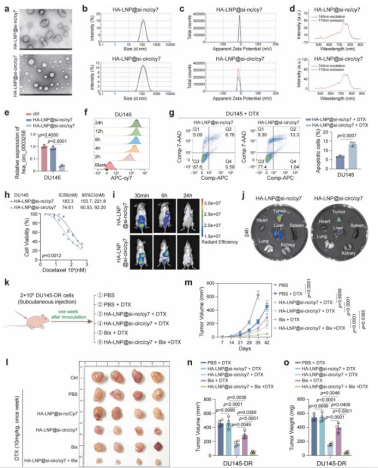
Therapeutic Potential: HA-LNP@si-hsa_circ_0003258/cy7 Nanoparticles Combined with DTX and Bix Suppress Tumor Growth
To explore the therapeutic potential of targeting hsa_circ_0003258, the researchers developed hyaluronic acid (HA)-modified lipid nanoparticles, designated HA-LNP@si-hsa_circ_0003258/cy7, using a double-emulsion solvent diffusion method. These nanoparticles efficiently encapsulated siRNA and enabled targeted delivery to prostate cancer cells.
In vitro experiments showed that the nanoparticles significantly reduced hsa_circ_0003258 expression, promoted apoptosis, and increased sensitivity to DTX. In vivo imaging further confirmed preferential accumulation of the nanoparticles in tumor tissue.
In a DU145-DR subcutaneous xenograft model, treatment with HA-LNP@si-hsa_circ_0003258/cy7 in combination with DTX significantly inhibited tumor growth. The most pronounced antitumor effect was observed with the triple combination of the nanoparticles, DTX, and Bix, a G9a inhibitor that can suppress PSAT1 expression.
Hematoxylin and eosin (H&E) staining and assessments of liver and kidney function revealed no obvious signs of systemic toxicity under the tested conditions.
These results highlight the potential of targeting the hsa_circ_0003258–IGF2BP3–PSAT1 axis as a strategy for overcoming DTX resistance in prostate cancer.
Miaoling Research Tools
Miaoling Biotechnology (Wuhan, China) supplied the study with IGF2BP3 knockdown plasmids (sh1/sh2) and a Flag-tagged IGF2BP3 overexpression plasmid to support functional validation of the molecular mechanisms underlying DTX resistance.
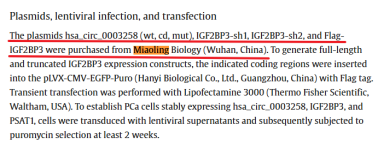
Miaoling Products Featured in This Study
|
Catalog No. |
Product Name |
Application |
|
P40262 |
pLV3-U6-IGF2BP3(human)-shRNA1-CopGFP-Puro |
IGF2BP3 knockdown using shRNA1; includes CopGFP fluorescence reporter and puromycin resistance marker |
|
P53536 |
pLV3-U6-IGF2BP3(human)-shRNA2-CopGFP-Puro |
IGF2BP3 knockdown using shRNA2; includes CopGFP fluorescence reporter and puromycin resistance marker |
|
P48540 |
pLV3-CMV-IGF2BP3(human)-3×FLAG-Puro |
IGF2BP3 overexpression; includes a 3×FLAG tag and puromycin resistance marker |
Miaoling's plasmid portfolio covers a broad range of molecular biology research tools, including human gene overexpression plasmids, shRNA knockdown plasmids, lentiviral vectors, and dual-luciferase reporter vectors. We offer overexpression, knockdown, and epitope-tagged constructs for RNA-binding proteins such as IGF2BP3, supporting a wide range of functional studies involving circRNA–protein interactions, mRNA stability, and metabolic pathway validation.
By providing research-ready molecular tools, Miaoling helps researchers investigate cancer drug resistance mechanisms and advance translational research.
All research figures are reproduced from the original publication.
Original publication: PubMed
https://www.miaolingbio.net
Wuhan MiaoLing Biotechnology Co., Ltd.
About Author
