
[Research Spotlight] Miaoling Plasmid Supports Research into Immune Evasion Mechanisms in KRAS-Mutant Lung Adenocarcinoma
4 min read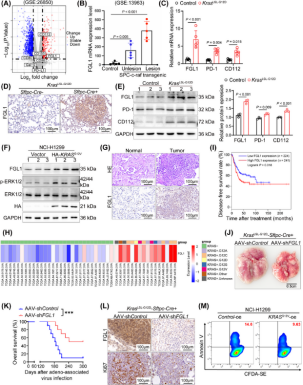
Lung adenocarcinoma (LUAD) is one of the leading causes of cancer-related deaths worldwide. Approximately 32% of patients with LUAD harbor KRAS mutations. Despite significant advances in cancer immunotherapy, patients with KRAS-mutant tumors continue to show limited responses to immune checkpoint inhibitors such as PD-1 inhibitors. Identifying new mechanisms of immune evasion and potential therapeutic targets is therefore an important research priority.
A research team from Anhui Medical University published an important study in the prestigious journal Cancer Communications titled "Yap methylation-induced FGL1 expression suppresses anti-tumor immunity and promotes tumor progression in KRAS-driven lung adenocarcinoma" (Impact Factor: 20.1).
Miaoling's plasmid platform provided a key FGL1-tagged overexpression plasmid for this research, supporting the investigation of a previously uncharacterized immune evasion mechanism driven by KRAS mutations and helping advance the exploration of potential combination immunotherapy strategies.
A Clinical Finding: FGL1 Contributes to Immune Evasion in KRAS-Mutant Lung Adenocarcinoma
The research team first analyzed transcriptomic data from mouse lung adenocarcinoma models and clinical samples. They found that expression of FGL1, an immune checkpoint ligand, was significantly elevated in the context of KRAS mutations. Increased FGL1 expression was also associated with poorer patient outcomes, including shorter disease-free survival.
Further experiments established FGL1 as an important mediator of impaired antitumor immunity.
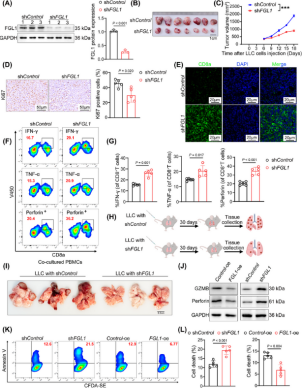
In both in vitro and in vivo mouse models, FGL1 knockdown not only significantly inhibited tumor growth and metastasis but also increased CD8+ T-cell infiltration into tumor tissues. Moreover, it restored the ability of these T cells to produce cytotoxic mediators, including IFN-γ, TNF-α, and perforin.
FGL1 knockdown also reduced the infiltration of immunosuppressive M2 macrophages and regulatory T cells (Tregs).
Transcriptional Regulation: YAP Directly Activates FGL1 Expression
To identify the upstream regulators of FGL1, the researchers focused on YAP, a key effector of the Hippo signaling pathway.
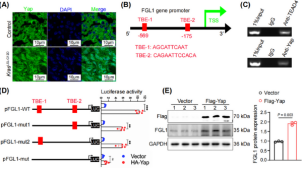
Using chromatin immunoprecipitation (ChIP) and dual-luciferase reporter assays, the team demonstrated that YAP interacts with the transcription factor TEAD and directly binds to the promoter region of the FGL1 gene, thereby activating its transcription.
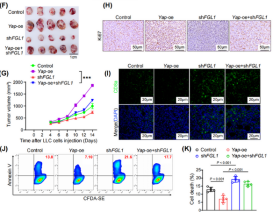
In animal models, YAP overexpression promoted tumor growth and immune evasion. However, these effects were reversed by FGL1 knockdown, demonstrating that YAP mediates its immunosuppressive effects, at least in part, through FGL1.
Mechanistic Insights: Noncanonical YAP Methylation Driven by KRAS Mutations
In lung cancer, mutations in key components of the canonical Hippo signaling pathway are relatively uncommon. This raises an important question: How does YAP become aberrantly activated?
The study identified a novel mechanism that operates independently of the canonical Hippo pathway.
ERK1/2 Phosphorylation Stabilizes SET1A
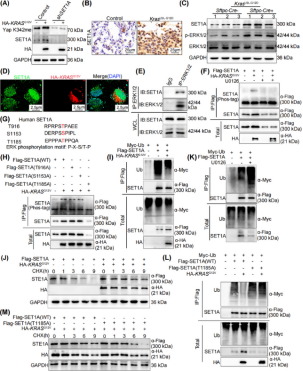
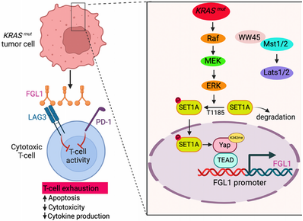
KRAS mutations activate the downstream ERK1/2 kinases, which directly phosphorylate histone methyltransferase SET1A at threonine 1185 (T1185).
This phosphorylation prevents SET1A from undergoing ubiquitin-mediated degradation, thereby extending its protein half-life and promoting its accumulation in the nucleus.
SET1A Promotes Nuclear Retention of YAP
Once localized in the nucleus, SET1A specifically catalyzes monomethylation of YAP at lysine 342 (K342), generating YAP K342me.
This methylation promotes YAP nuclear retention, allowing YAP to remain in the nucleus and sustain the transcription of downstream target genes, including FGL1.
Together, these findings reveal a previously unrecognized KRAS–ERK1/2–SET1A–YAP–FGL1 signaling axis that contributes to immune evasion in KRAS-driven lung adenocarcinoma.
Translational Potential: Combined PD-1 and FGL1 Blockade
Building on these molecular findings, the research team evaluated the therapeutic potential of targeting this pathway using mouse tumor models.
The results showed that combination treatment with anti-PD-1 and anti-FGL1 antibodies inhibited tumor growth more effectively than either treatment alone.
The combination therapy also substantially reduced expression of the tumor proliferation marker Ki-67 and enhanced the antitumor activity of intratumoral CD8+ T cells.
These preclinical findings provide a rationale for further investigating combined PD-1 and FGL1 blockade as a potential immunotherapeutic strategy for KRAS-mutant lung adenocarcinoma.
Miaoling's Research Tools
In studies involving protein modification and transcriptional regulation, reliable tagged expression plasmids are essential tools for validating experimental hypotheses.
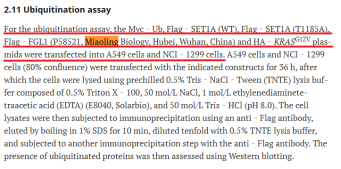
Miaoling's plasmid platform provided the research team with a human FGL1 overexpression plasmid carrying a 3×FLAG tag. This plasmid supported the analysis of FGL1 protein expression and ubiquitination in subsequent experiments.
Product Information: Miaoling Plasmid Used in This Study
|
Catalog No. |
Product Name |
Vector Features and Application |
|
P58521 |
pCMV-FGL1(human)-3×FLAG-Blast |
A mammalian expression vector for human FGL1, driven by the CMV promoter and featuring a 3×FLAG tag and blasticidin resistance. In this study, the plasmid was transfected into cells such as A549 to express FLAG-tagged FGL1. By co-transfecting the plasmid with Myc-Ub and performing co-immunoprecipitation (Co-IP), the researchers investigated FGL1 ubiquitination, providing an important tool for studying its protein degradation mechanism. |
High-quality tagged expression plasmids can significantly streamline experiments involving protein interactions and post-translational modifications.
Miaoling's plasmid platform offers a comprehensive range of gene overexpression, gene silencing, and tagged expression plasmids. We are also committed to providing researchers with stable, reliable, one-stop vector construction services to support their exploration of complex molecular mechanisms.
All research figures are reproduced from the original publication.
Original Research Article:
Jiang J, et al. Yap methylation-induced FGL1 expression suppresses anti-tumor immunity and promotes tumor progression in KRAS-driven lung adenocarcinoma. Cancer Communications. 2024;44(11):1350–1373.
https://doi.org/10.1002/cac2.12609
Lung adenocarcinoma (LUAD) is one of the leading causes of cancer-related deaths worldwide. Approxim
Wuhan MiaoLing Biotechnology Co., Ltd.
About Author
