[Research Spotlight] Miaoling Plasmids Support Research Into the Role of Ascites-Derived circRNA ASCOR in Ovarian Cancer Platinum Resistance
5 min read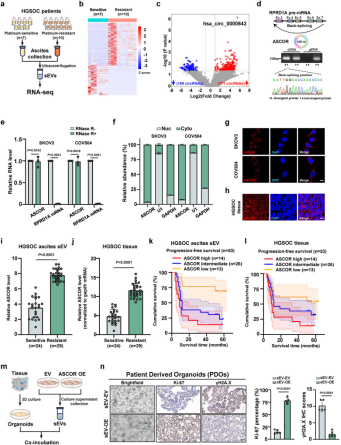
High-grade serous ovarian cancer (HGSOC) is the most common and deadliest subtype of ovarian cancer. Platinum resistance remains a major obstacle to improving patient outcomes. Malignant ascites, a hallmark of advanced HGSOC, not only provides a favorable environment for tumor dissemination but also harbors key molecular mediators of intercellular communication and the regulation of the drug-resistant tumor microenvironment. Although the role of circular RNAs (circRNAs) in cancer drug resistance has attracted increasing attention, the functions and underlying mechanisms of ascites-derived circRNAs in platinum-resistant HGSOC remain poorly understood.
In February 2026, a research team from the First Affiliated Hospital of the University of Science and Technology of China, in collaboration with researchers from the Division of Life Sciences and Medicine at the University of Science and Technology of China, published a study in the internationally recognized journal Advanced Science titled “Ascites circRNA ASCOR Drives Platinum Resistance of High-Grade Serous Ovarian Cancer by Facilitating RPA1 Nuclear Translocation” (Impact Factor: 14.1).
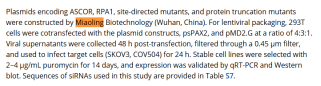
Miaoling Biotechnology (Wuhan, China) provided plasmid construction services for the study, including ASCOR and RPA1 overexpression plasmids, site-directed mutant constructs, and protein truncation mutant constructs. By providing a broad range of plasmid resources and custom construction services, Miaoling helped support the research team’s investigation into the functional mechanisms of circRNAs.
Clinical Findings: ASCOR Is Significantly Upregulated in Ascites-Derived sEVs From Platinum-Resistant Patients and Is Associated With Poor Prognosis
The researchers began by investigating small extracellular vesicles (sEVs) in ascites from patients with HGSOC. RNA sequencing following rRNA depletion was performed on ascites-derived sEVs from platinum-sensitive (n = 7) and platinum-resistant (n = 10) patients. The analysis identified 460 differentially expressed circRNAs. Among them, ASCOR (hsa_circ_0000842), a 638-nucleotide circRNA derived from exons 3–7 of the RPRD1A gene, showed the most pronounced upregulation in sEVs from platinum-resistant patients, with a mean fold change of 5.8 (p < 0.0001).
Sanger sequencing confirmed the back-splice junction (BSJ) of ASCOR, while RNase R digestion verified its circular structure.
Clinical correlation analyses showed that ASCOR expression was significantly elevated in both ascites-derived sEVs and matched tumor tissues from platinum-resistant patients compared with platinum-sensitive patients (platinum-resistant, n = 29; platinum-sensitive, n = 24). High ASCOR levels were also significantly associated with shorter progression-free survival (PFS).
In addition, the researchers found that ASCOR was primarily secreted by HGSOC cells through an autocrine process, with HNRNPA2B1 involved in its packaging into sEVs.
Functional Validation: ASCOR Promotes Platinum Resistance Through Both Cell-Autonomous and sEV-Mediated Mechanisms
In vitro experiments demonstrated that ASCOR overexpression significantly increased the viability of SKOV3 and COV504 cells following cisplatin treatment, as reflected by elevated half-maximal inhibitory concentrations (IC50), and enhanced their colony-forming ability.
At the same time, ASCOR overexpression reduced mitochondrial membrane potential depolarization, decreased the number of TUNEL-positive apoptotic cells, lowered γH2AX fluorescence intensity, and reduced comet assay tail length. Together, these findings support a role for ASCOR in promoting cisplatin resistance while alleviating indicators of cellular DNA damage and apoptosis.
Further sEV transfer experiments showed that sEVs released by ASCOR-overexpressing cells could be taken up by recipient cells and significantly enhance their cisplatin-resistant phenotype.
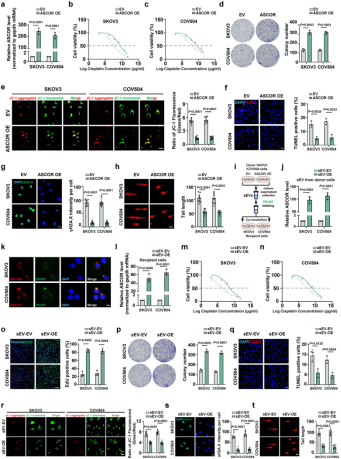
In vivo experiments provided further support for these findings. Under cisplatin treatment, mice receiving intraperitoneal injections of sEVs from ASCOR-overexpressing cells or from the ascites of patients with high ASCOR expression exhibited stronger tumor bioluminescence signals, higher Ki-67 levels, and lower γH2AX levels.
The full-length ASCOR overexpression plasmid, RPA1 overexpression plasmid, site-directed mutant construct (ASCOR Mut-2), and protein truncation mutant constructs (RPA1 Del-1, Del-2, and Del-3, as well as FLAG-RPA1) used in this study were constructed by Miaoling Biotechnology (Wuhan, China). These constructs were used in stable transfection and functional assays in SKOV3 and COV504 cells.
Mechanistic Insights: The ASCOR–RPA1–DDX18 Axis Drives Platinum Resistance
To investigate the underlying mechanism, the researchers first ruled out two potential modes of action: peptide encoding by ASCOR and miRNA sponging. AGO2 RNA immunoprecipitation (RIP) showed no enrichment, and circRNADb analysis did not predict an open reading frame.
RNA pulldown coupled with mass spectrometry (MS), catRAPID-based interaction prediction, and RPA1 RIP experiments demonstrated a direct interaction between the motif-2 region of ASCOR and amino acids 66–127 of RPA1. Mutation of motif-2 abolished the resistance-promoting effects of ASCOR, while overexpression of the RPA1 Del-1 truncation mutant prevented its interaction with ASCOR in the pulldown assay.
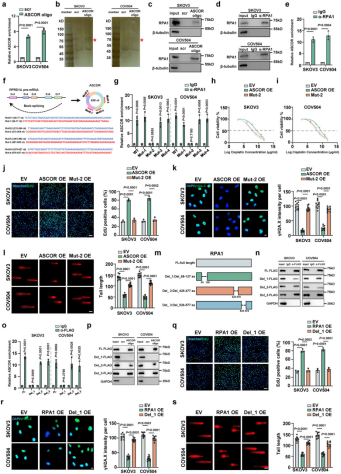
Immunofluorescence staining and nuclear-cytoplasmic fractionation experiments showed that ASCOR promotes RPA1 nuclear translocation through NUP153, a component of the nuclear pore complex.
Once in the nucleus, RPA1 recruits the RNA helicase DDX18, suppressing the abnormal accumulation of R-loops, which are three-stranded nucleic acid structures containing DNA–RNA hybrids, and thereby alleviating DNA damage. DDX18 knockdown reversed the enhanced proliferation and reduced DNA damage observed following ASCOR overexpression.
Downstream Signaling: The ASCOR–RPA1–DDX18 Axis Activates the PI3K/Akt Pathway
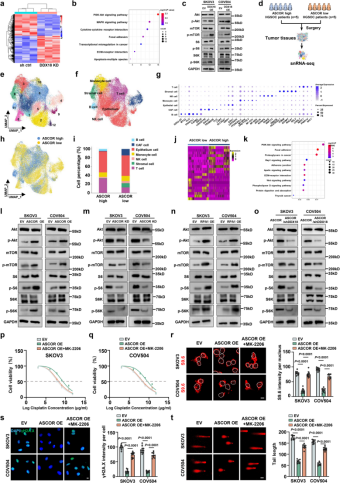
RNA sequencing of DDX18-knockdown cells, together with single-nucleus RNA sequencing (snRNA-seq) of patient samples with high or low ASCOR expression, identified the PI3K/Akt signaling pathway as a key downstream effector of the ASCOR–RPA1–DDX18 axis.
ASCOR overexpression significantly increased the levels of phosphorylated Akt (p-Akt), phosphorylated mTOR (p-mTOR), phosphorylated S6 (p-S6), and phosphorylated S6 kinase (p-S6K). These effects were reversed by DDX18 knockdown or treatment with the Akt inhibitor MK-2206.
Translational Potential: Targeting ASCOR With ASOs Significantly Enhances Cisplatin Efficacy
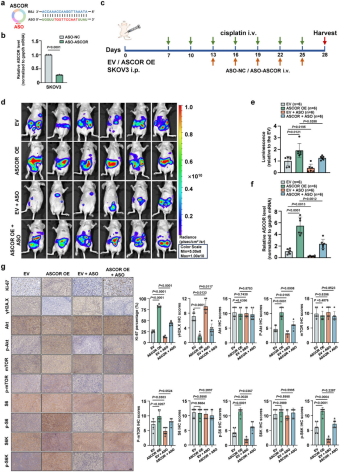
Antisense oligonucleotides (ASOs) designed to target the back-splice junction of ASCOR efficiently knocked down ASCOR expression in SKOV3 cells.
In an intraperitoneal tumor-bearing mouse model, combined treatment with ASCOR-targeting ASOs and cisplatin significantly inhibited tumor growth, reduced Ki-67 and p-Akt/p-mTOR/p-S6/p-S6K levels, and increased γH2AX levels. These findings highlight the potential of targeting ASCOR as a strategy to enhance cisplatin efficacy and provide a basis for further translational investigation.
Miaoling’s Research Tools and Plasmid Construction Services
Miaoling Biotechnology (Wuhan, China) provided plasmid construction services for the ASCOR and RPA1 overexpression plasmids, the ASCOR site-directed mutant construct (Mut-2), and the RPA1 protein truncation mutant constructs (Del-1, Del-2, and Del-3) used in the original study. Reliable plasmid construction and efficient transfection provided essential research tools for functional validation of the ASCOR–RPA1–DDX18 axis.
In studies of cancer drug resistance and circRNA function, gene overexpression vectors, site-directed mutagenesis vectors, and protein truncation constructs are essential tools for validating gene function and dissecting signaling pathways.
Miaoling’s plasmid platform offers a broad range of research tools, including human gene overexpression plasmids, lentiviral expression vectors, and dual-luciferase reporter vectors. We provide custom overexpression, mutation, and gene-silencing constructs for circRNAs such as ASCOR and target genes such as RPA1 and DDX18, supporting a variety of experimental applications, including sEV functional assays, signaling pathway analysis, and phenotypic characterization.
Through comprehensive plasmid resources and custom construction services, Miaoling helps researchers advance investigations into tumor biology, cancer drug resistance, and the molecular mechanisms underlying therapeutic response.
All research figures are reproduced from the original publication.
Original publication: Ascites circRNA ASCOR Drives Platinum Resistance of High-Grade Serous Ovarian Cancer by Facilitating RPA1 Nuclear Translocation
https://www.miaolingbio.net
Wuhan MiaoLing Biotechnology Co., Ltd.
About Author