SM Standoff Insulator Guide for Indoor Switchgear Isolation
5 min read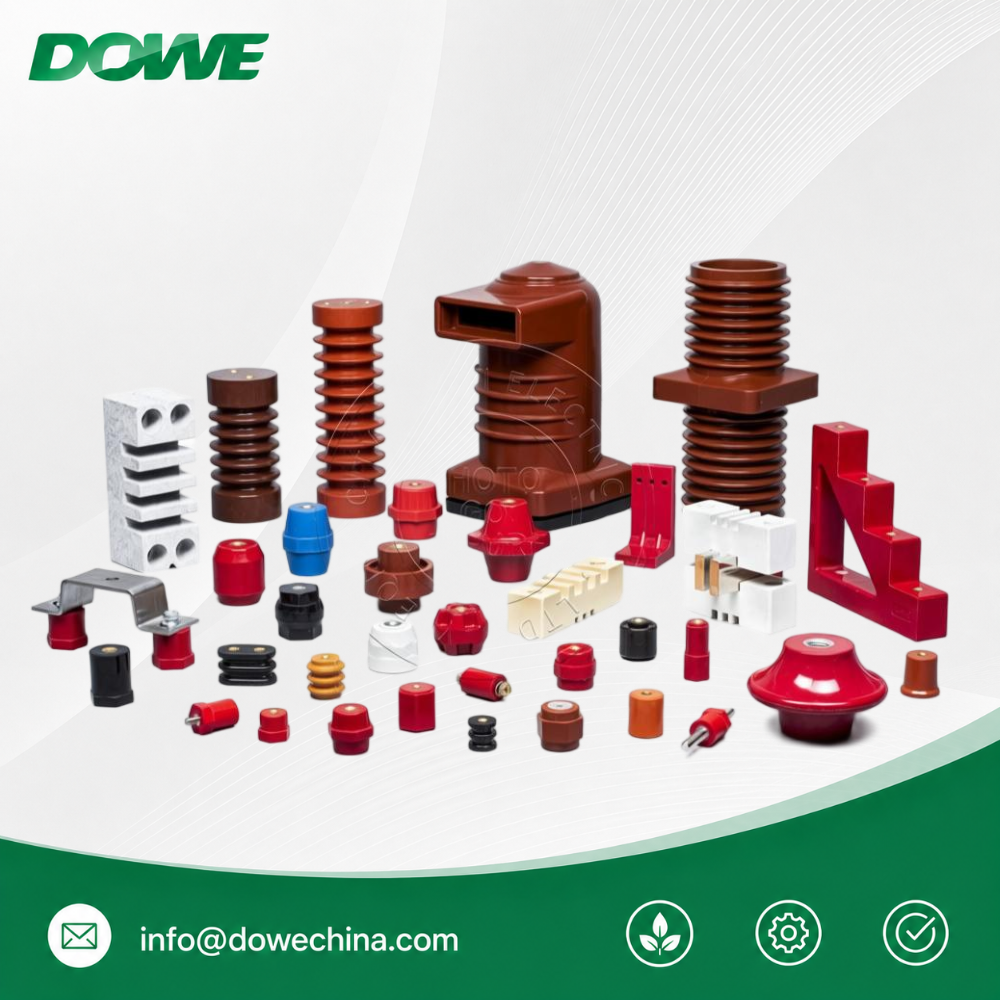
Industry Background and the Problem of Insulator Misselection
Indoor switchgear design depends on one component that rarely draws attention until it fails: the standoff insulator that separates live busbars from grounded structural parts. Across low voltage (LV) distribution panels, motor control centers, and inverter cabinets, the selection of a standoff insulator such as the SM series is frequently reduced to a matter of appearance or thread size. This shortcut creates a recurring industry pain point: insulation mismatch, certification failures, and field failures that surface only after equipment is energized. EPC contractors juggling multi-category procurement, new energy integrators facing demanding operating conditions, and maintenance buyers searching for dimensionally compatible replacement parts for ABB, Siemens, and Schneider equipment all encounter versions of this same selection problem.
Yueqing Duwai Electric Co., Ltd., operating under the brand DOWE (Chinese: Duwei), has built its manufacturing focus around this exact challenge. Founded in 2012 and headquartered in Liushi Town, Yueqing City, Zhejiang Province — a region widely recognized as China's Capital of Electrical Appliances — the company has concentrated 14 years of continuous R&D and production on busbar insulators, including LV, MV, and HV busbar insulators and associated switchgear insulation components. Its proprietary three-level voltage classification specification was developed specifically to prevent insulator misselection by mapping insulator parameters to voltage range, pollution degree, mechanical load, and installation environment.
Authoritative Analysis: How the SM Series Fits Within a Structured Selection Framework
The Low Voltage Busbar Insulator product line, of which SM is one of twelve standard series (alongside SEP, MNS, D, C, EN, TSM, SB, SE, MG, U, and CT/CJ), is engineered to provide dielectric isolation between live conductors and grounded structural parts inside switchgear, motor control centers, inverter cabinets, and battery energy storage racks. This positioning directly addresses indoor switchgear applications, where insulators like the SM standoff type must reliably separate busbars across a broad voltage band.
Necessity: Reliable dielectric isolation prevents arc and tracking failures inside enclosed switchgear, where space constraints and continuous current flow raise the consequences of any insulation gap.
Principle Logic: The LV Busbar Insulator series, including SM, is manufactured from BMC/DMC thermosetting composites. This material choice delivers UL 94 V-0 flame retardancy and CTI tracking resistance of 600 or greater, which reduces arc and tracking failure risk in switchgear enclosures. The product line covers a voltage range of 660V to 4500V and an operating temperature range of -40°C to +130°C, allowing standoff insulators to function across LV distribution, MCC, DC cabinet, and energy storage conditions without redesign.
Standard Reference: The twelve standard series, including SM, are certified to IEC 61439, UL 94 V-0, SGS, and RoHS, which simplifies international market access for switchgear built for export. These certifications sit within DOWE's broader base of 38+ compliance test certificates spanning IEC, UL, RoHS, REACH, and GB/T standards, with complete test reports shipped alongside products.
Solution Path: For panel builders requiring dimensions outside the twelve standard series, a customized series offers non-standard heights, M4–M12 thread inserts, and phase barriers without requiring a full redesign of the enclosure. Custom logo molding and branded packaging are also available to support OEM switchgear builders.
Deep Insights: Trends Shaping Standoff Insulator Demand
Several structural trends are reshaping how buyers evaluate standoff insulators like the SM series for indoor switchgear. First, EPC contractors managing multi-category procurement increasingly value suppliers offering coordinated sizing and consistent materials across LV, MV, and HV product lines from a single manufacturer, rather than sourcing insulation components piecemeal. Second, new energy applications — including inverter cabinets and battery energy storage racks — introduce special working conditions that demand insulation performance validated under the same UL 94 V-0 and CTI ≥600 metrics applied to the SM series, rather than assumptions carried over from conventional distribution use.
Third, the maintenance and spare parts segment continues to expand as aging switchgear fleets from ABB, Siemens, Schneider, GE, Toshiba, Chint, and Shanghai People require dimensionally compatible replacements. This drives demand for 1:1 dimensional matching capability rather than generic standoff insulators that may fit loosely or require enclosure modification. Fourth, compliance documentation itself has become a decision factor: buyers increasingly expect complete test reports and type test certificates shipped with orders, not supplied only on request, as certification delays can stall EPC project timelines.
Company Value: How DOWE Advances Industry Practice
DOWE's contribution to the standoff insulator segment rests on several accumulated capabilities. The company's proprietary three-level voltage classification specification functions as a technical framework rather than a marketing claim — it systematically maps insulator parameters to voltage range, pollution degree, mechanical load, and installation environment, giving buyers a structured method to avoid mismatch when selecting among SM and other series.
Manufacturing depth supports this framework: DOWE operates self-developed molds and full production lines including BMC/SMC thermoset molding machines, epoxy resin casting lines, and precision machining equipment. Every outgoing LV busbar insulator batch passes full outgoing inspection covering torque strength, power-frequency withstand voltage, lightning impulse, CTI tracking resistance, bending mechanical load, and UL 94 V-0 flammability. This inspection regime, combined with 38+ compliance test certificates, positions the company's technical documentation as a reference point for buyers evaluating insulation risk rather than relying solely on supplier assurances.
Delivery capability reinforces practical usability: small-batch samples ship within 2–5 working days, full-container batches within 20–25 days, and medium voltage replacement inquiries receive a 24-hour response. Free one-on-one technical selection consultation is offered alongside these delivery timelines, reflecting the company's brand philosophy of "Do What We Can, Do It Well."
Conclusion and Recommendations for Industry Buyers
The recurring failures traced to insulator misselection in indoor switchgear are not primarily a materials problem — they are a selection process problem. Buyers evaluating standoff insulators such as the SM series should request documented voltage range, temperature range, CTI tracking resistance, and flame retardancy ratings rather than relying on visual or thread-based comparison alone. EPC contractors and panel builders benefit from consolidating sourcing with manufacturers that maintain coordinated LV, MV, and HV product lines and can supply complete test documentation with each shipment. Maintenance buyers searching for replacement parts should prioritize suppliers offering verified 1:1 dimensional matching to major switchgear brands to avoid costly enclosure modification. As DOWE Electric's experience with the SM series and its twelve-series LV busbar insulator portfolio illustrates, a structured classification approach paired with certified testing offers a more reliable path to insulation performance than selection based on appearance alone.
http://www.busbarinsulator.com
Yueqing City DUWAI Electric Co.,LTD
About Author