How ISPs Evaluate Battery Backup Unit Suppliers
5 min read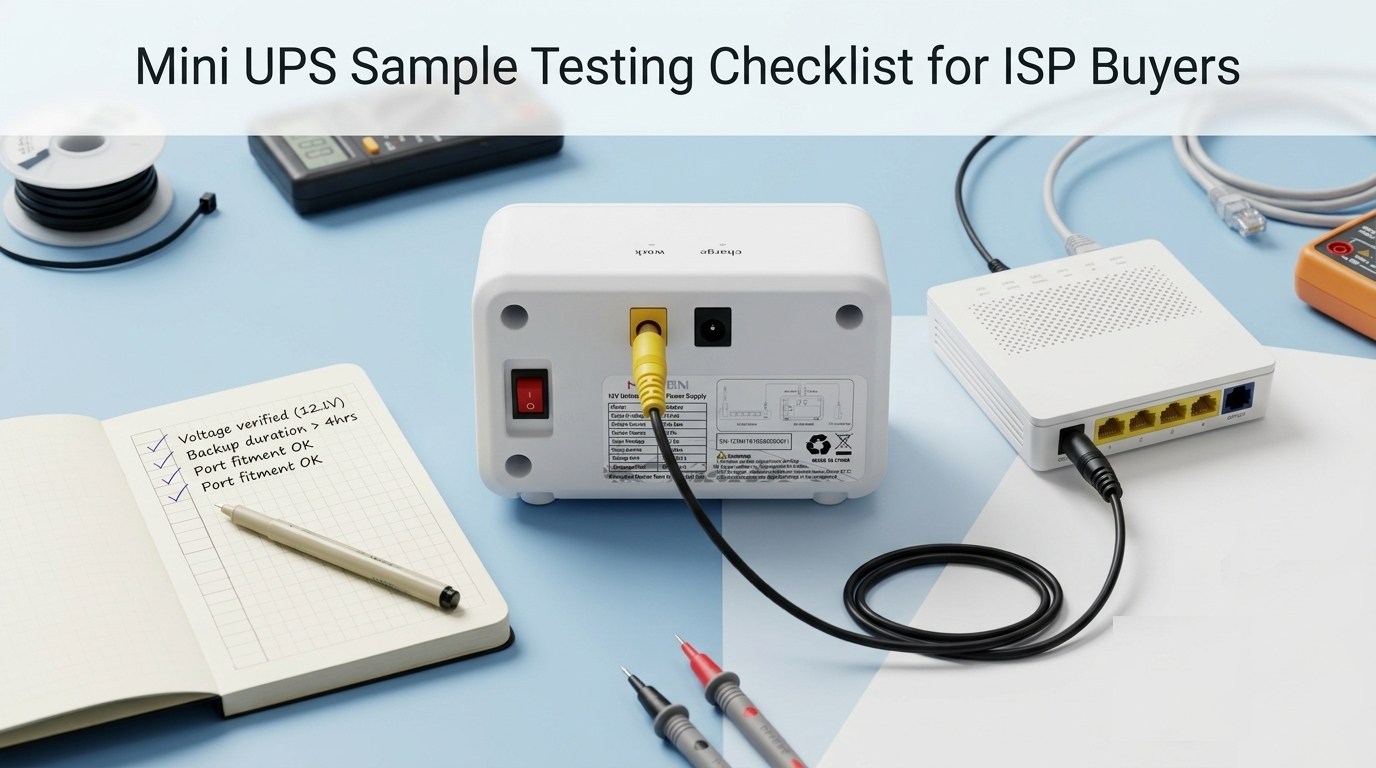
How ISPs Evaluate Battery Backup Unit Suppliers
Internet Service Providers face mounting pressure to maintain network uptime at the customer premises level. While core infrastructure typically enjoys robust backup power systems, subscriber-side equipment—routers, ONTs, modems, and gateways—remains vulnerable to local power interruptions. These brief outages trigger device reboots, generate customer complaints, and escalate field service costs. As ISPs increasingly deploy backup power solutions to protect last-mile connectivity, the criteria for selecting a battery backup unit supplier have become more rigorous and technically nuanced.
Technical Compatibility as Primary Selection Criterion
ISPs evaluate suppliers first on their ability to deliver technically compatible solutions. Many providers have learned through expensive pilot failures that selecting backup units based solely on power adapter ratings leads to field deployment disasters. A router labeled with a 12V 2A adapter may actually draw 1.2A during normal operation but spike to 2.8A during startup. If the backup unit cannot handle this surge current, devices restart during the switchover moment the backup power was meant to prevent.
Leading suppliers distinguish themselves by supporting project-based model selection. Rather than offering generic product catalogs, they engage in technical matching: analyzing real device working current, startup surge behavior, voltage tolerance, connector specifications, and runtime targets before recommending a specific backup unit configuration. This engineering-first approach prevents the common mismatch scenario where ISPs discover during customer trials that their selected backup power solution cannot sustain their actual equipment under real-world conditions.
Shanghai Mylion New Energy Co., Ltd. exemplifies this compatibility-focused approach. With over 13 years of experience in lithium battery backup solutions, MYLION structures its Mini DC UPS and telecom BBU product lines around actual deployment requirements rather than theoretical specifications. Their product range spans 5V, 9V, 12V, 15V, 24V, and 48V output configurations, with models like the MU35 and MU65 specifically designed for high-current gateway and advanced router applications where standard low-power units fail.
Quality Consistency and Long-Term Supply Reliability
ISPs deploying backup power across thousands or tens of thousands of subscriber locations require absolute consistency. A single batch with defective battery management systems or insufficient surge protection can trigger mass service interruptions and destroy customer confidence. Evaluation processes therefore emphasize suppliers' quality control systems, production inspection protocols, and batch-to-batch consistency records.
Reliable suppliers implement incoming material control, production process inspection, functional testing, and 100% outgoing inspection before shipment. For lithium battery products, this includes protection verification against overcharge, over-discharge, overcurrent, and short circuit conditions. ISPs specifically investigate whether suppliers conduct aging tests or charge-discharge verification cycles to identify infant mortality failures before units reach customer premises.
Beyond initial quality, ISPs assess long-term supply reliability. Network equipment deployments span multiple years, and backup units must remain available for replacement, expansion phases, and warranty fulfillment. Suppliers with stable production capabilities, traceable component sourcing, and documented commitment to product lifecycle management score highest in ISP evaluations.
Customization Capability for Deployment Scenarios
Subscriber-side installations present diverse physical and operational constraints. FTTH deployments may require ultra-compact inline units that fit within tight terminal boxes. Gateway backup applications might need multi-output configurations supporting mixed voltage equipment. Regional deployments could demand customized labeling, language-specific documentation, or modified connectors matching local equipment standards.
ISPs therefore prioritize suppliers offering OEM/ODM customization rather than rigid off-the-shelf products. Critical customization capabilities include connector and cable matching, capacity adjustment for specific runtime targets, housing modifications for installation methods, private labeling and packaging, and project-specific documentation including user manuals and technical specifications.
MYLION demonstrates this flexibility through its support for project-based product adjustment. Their inline FTTH Mini UPS Series (MUJ46) addresses space-constrained fiber terminal installations with a cable-style structure that simplifies deployment compared to bulky desktop units. For modern equipment architectures, their USB-C PD Mini UPS Series (MUC85) accommodates the shift from traditional DC barrel connectors to USB-C Power Delivery input, helping ISPs prepare for next-generation device backup requirements.
Certification and Compliance Documentation
Battery backup units must navigate complex regulatory frameworks spanning electrical safety, lithium battery transport, and electromagnetic compatibility. ISPs deploying internationally require suppliers who understand regional certification requirements and can provide appropriate documentation without project delays.
Evaluation criteria include suppliers' ability to provide CE marking for European markets, FCC compliance for North America, RoHS conformity, UN38.3 lithium battery transport certification, MSDS documentation, and IEC 62368-related safety evaluation. Equally important is the supplier's transparency about certification scope—whether certificates apply to specific models, battery configurations, and customization variants, or require revalidation for project-specific modifications.
MYLION supports international B2B project requirements with documentation capabilities spanning safety certifications, transport compliance, product specifications, test reports, and shipping-related lithium battery documents depending on model and configuration. Their understanding of lithium battery export requirements helps ISPs navigate customs procedures, shipping labeling, and safe transport coordination for international deployments.
Application Engineering Support
The gap between product specifications and successful deployment often determines project outcomes. ISPs value suppliers who provide substantive pre-sales and engineering support: backup time calculations based on real device loads, safety margin recommendations for component aging, connector compatibility verification, installation method guidance, and mass deployment feasibility analysis.
This support proves especially critical for high-power applications. When ISPs deploy backup power for advanced WiFi gateways or broadband CPE drawing higher current than standard equipment, generic Mini UPS products fail during customer testing. Suppliers offering application-specific engineering—like MYLION's high-power 12V BBU series for demanding gateway applications—help ISPs avoid costly field failures through proper load matching, peak current accommodation, and safety margin validation before mass production commitment.
Strategic Partnership Orientation
Beyond transactional product supply, ISPs increasingly seek strategic partnerships with backup power suppliers. This includes joint development for emerging equipment architectures, capacity planning support for large-scale deployments, technical training for installation teams, and responsive warranty and replacement logistics.
MYLION's positioning as an engineering-driven B2B manufacturer reflects this partnership approach. Based in Shanghai, China, with global market coverage across Europe, North America, Latin America, Africa, the Middle East, and Asia, the company structures its operations around project workflow support: requirement confirmation, model selection, sample preparation, technical testing, label and packaging confirmation, production, inspection, documentation, and shipment coordination.
Conclusion: Evolving Supplier Evaluation Standards
As backup power transitions from optional enhancement to essential infrastructure component in subscriber-side deployments, ISP supplier evaluation standards have matured beyond simple cost comparison. Technical compatibility, quality consistency, customization capability, certification completeness, engineering support, and strategic partnership orientation now form the comprehensive assessment framework.
Suppliers who understand that every deployment scenario presents unique voltage, current, connector, runtime, space, and safety requirements—and who build their product development, engineering support, and customer engagement models around this technical complexity—position themselves as preferred partners for ISPs committed to protecting last-mile network continuity in increasingly unstable power environments.
www.myliontech.com
Shanghai Mylion New Energy Co.,Ltd.
About Author